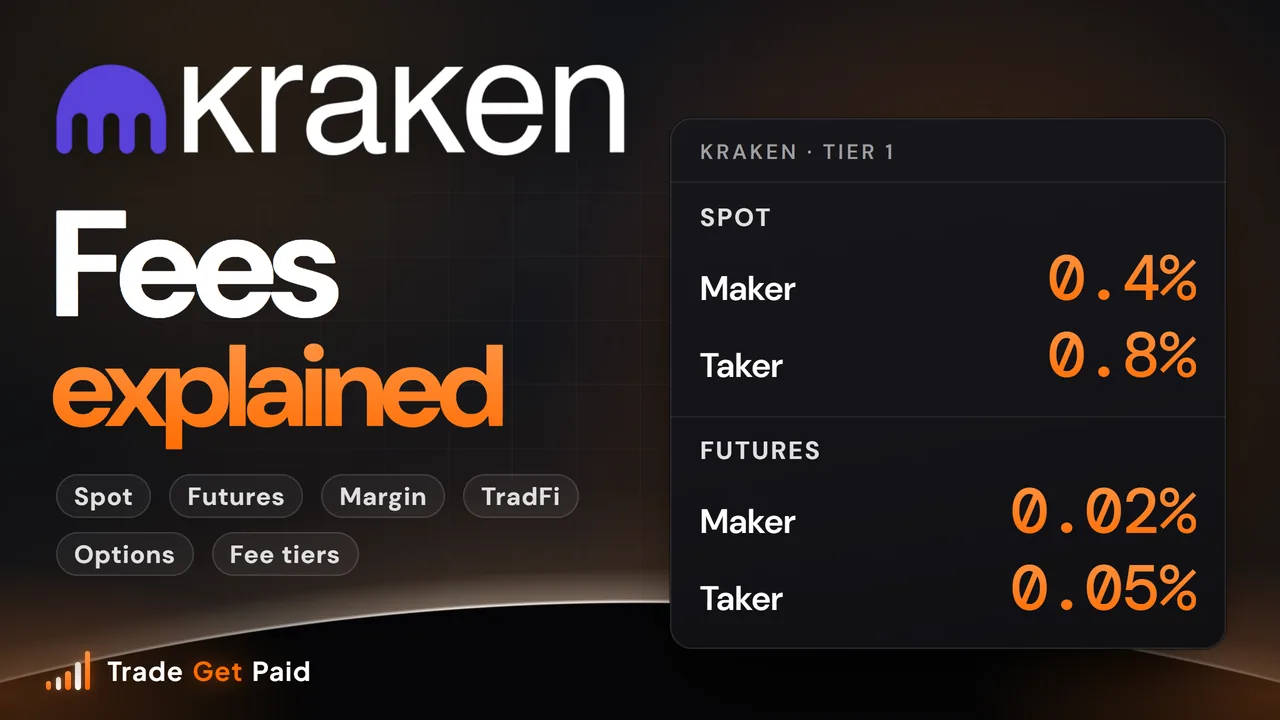
- Spot: a new account on Kraken Pro is in Tier 1 and pays 0.40% as a maker and 0.80% as a taker.
- Futures: 0.02% maker and 0.05% taker on the full position value, paid when you open and again when you close.
- Funding settles every hour on Kraken, where most exchanges settle it every 8 hours. It builds up for as long as your position is open, and it passes between traders, never to Kraken.
- Other markets: stock, gold, oil and currency perps cost the same as crypto perps. xStocks, margin, stablecoin pairs and options have fees of their own.
- Fee tiers lower the rates. Meeting one of three requirements is enough, and $2,500 of spot volume in 30 days reaches Tier 2.
- TradeGetPaid returns 40% of your futures fees, an effective 0.012% maker and 0.03% taker. Spot fees aren’t covered.
Kraken fees at a glance
| Fee | Maker | Taker |
|---|---|---|
| Spot (Kraken Pro) | 0.40% | 0.80% |
| Futures (crypto perpetuals) | 0.02% | 0.05% |
| TradFi perpetuals (stocks, gold, oil, currencies) | 0.02% | 0.05% |
| xStocks (tokens that follow shares) | 0.00% | 0.08% |
| Stablecoin and currency pairs (such as USDT/USD) | 0.20% | 0.20% |
Rates for a new account with no trading volume. More volume lowers them. Margin trades add an opening fee and a fee every 4 hours, and options pay a capped fee at settlement. Holding a perpetual position adds funding every hour, which goes to or comes from other traders, never Kraken.
If you’d rather watch than read, we also have a video guide on Kraken fees.
 Play the video: Kraken Fees Explained (Spot, Futures, VIP Levels) And How To Reduce your Kraken Fees by 40%
Kraken fees explained (5:40).
Pressing play loads the video from YouTube. Privacy policy
Maker or taker: which fee you pay
A market order fills immediately against orders already waiting in the order book. It takes liquidity out of the order book, so you pay the taker fee.
A limit order that goes into the order book and waits adds liquidity, and when another trader fills it, you pay the maker fee. Kraken’s derivatives fee article puts it this way: an order that “first sits in the order book before it is matched” pays the maker fee, and one that “crosses the order book and is immediately matched” pays the taker fee. A limit order priced so that it fills the moment you place it therefore pays the taker fee too.
On Kraken the maker fee is lower than the taker fee on spot and on futures, so the order type changes what you pay on every trade. Our maker vs taker guide has a section on when a limit order pays the taker fee.
Kraken spot fees
On spot you own what you buy: the coin sits in your Kraken account until you sell or withdraw it. On Kraken Pro a new account is in Tier 1 and pays 0.40% as a maker and 0.80% as a taker.
A $1,000 Bitcoin buy with a market order costs $8 in fees. With a limit order that waits on the book, it costs $4. Selling it again at the same price costs the same amount once more.
Binance and Bybit, for comparison, take 0.1% from a regular account on spot, for makers and takers alike. Kraken’s spot fees for a new account are higher on both sides.
These are Kraken Pro’s rates. The simple Kraken app charges 1% on instant and recurring buys and sells and 1.5% on custom orders, with a spread included in the price as well. Instant Buy volume doesn’t count toward your fee tier.
Kraken futures fees
Kraken’s perpetual futures, or perps, are contracts that track a coin’s price. You don’t own the coin, so there’s nothing to withdraw, and you can go long (bet on a rise) or short (bet on a fall). Leverage lets your margin carry a bigger position: up to 100x on the Bitcoin, Ether and Solana perps outside the European Economic Area, and up to 10x inside it. Kraken’s perps aren’t offered in every country, and its eligibility page lists where they are not.
A new account pays 0.02% as a maker and 0.05% as a taker. Both rates are far below the spot rates, but with leverage they are charged on more money than you put in.
Why leverage makes futures fees bigger
Kraken’s derivatives fee article says the fees are “calculated as a percentage of the notional order value for a matched trade”. That is the full value of your position, not the margin you put in.
Put $1,000 of margin into a trade at 10x and you hold a $10,000 position. At the taker rate, a market order to open it costs $5, and closing it at the same price costs another $5. Together that’s $10, and you pay it whether the trade makes money or not. With limit orders that wait on the book, each side costs $2 instead.
Repeat the round trip with market orders 20 times in a month and the fees come to $200.
Funding fees on perpetual futures
Holding a perpetual contract also means funding: money that moves between the traders who are long and those who are short, to keep the contract’s price close to the coin’s spot price. Kraken keeps none of it. Its contract specifications say funding payouts “occur strictly between counter-parties”, and its fee article says funding “is not a fee charged by the exchange”. It’s money paid or received in addition to your trading fees.
- Longs pay shorts: if the funding rate is positive, long positions pay short positions. Hold a long position worth $10,000 while the rate is +0.001% an hour, and you pay 10 cents every hour, which goes to the short positions.
- Shorts pay longs: if the funding rate is negative, short positions pay long positions. At -0.001% an hour, a short position worth $10,000 pays 10 cents every hour to the long positions.
- When: most exchanges settle funding every 8 hours. Kraken settles it every hour, at the end of the hour, or sooner when you change your position.
- For as long as the position is open: Kraken says positions “continuously receive or send funding while open”. Funding builds up every moment your position is open, and closing it settles what has built up so far. So closing before the hour doesn’t skip it.
- How much: the position value times the funding rate. The 0.001% above is our example, not a Kraken figure.
- Range: Kraken keeps the rate between -0.5% and +0.5% an hour.
Other markets on Kraken Pro
Kraken Pro has more to trade than crypto, and each market has its own fees.
- TradFi perps: stocks, gold, oil and currencies trade as perpetual futures at the same 0.02% maker and 0.05% taker as crypto perps, with funding every hour. Kraken has one fee table for all its derivatives.
- xStocks: tokens that follow shares such as Apple and NVIDIA trade on spot at 0.00% for makers and 0.08% for takers on a new account, and more 30-day spot volume lowers the taker fee. xStocks aren’t offered in every country.
- Margin trading on spot: opening a position costs 0.01% to 0.05% of the amount lent to you, depending on the pair, and the same rate again every 4 hours the position stays open. The usual trading fee is charged on top when you open and when you close. Kraken offers up to 10x on selected assets.
- Stablecoin and currency pairs, such as USDT/USD or EUR/USD, cost 0.20% for makers and takers alike on a new account. These trades don’t count toward your 30-day volume.
- Options on Bitcoin and Ether have the same fee structure as Kraken’s other derivatives, worked out on the full contract value, but never more than 12.5% of the option’s price. The fee is charged at settlement, not when you trade. Kraken’s options aren’t available to residents of the US or the EU.
Kraken fee tiers
Kraken calls its levels fee tiers: Tier 1 to Tier 12, then Pro 1 to Pro 5. Since 9 July 2026 one tier sets both your spot and your futures fees. Your tier is the best of three measures: your 30-day spot volume, your 30-day futures volume, or your assets on the platform. Meeting one of the three requirements is enough.
| Tier | Spot maker | Spot taker | Futures maker | Futures taker |
|---|---|---|---|---|
| Tier 1 | 0.40% | 0.80% | 0.02% | 0.05% |
| Tier 2 | 0.30% | 0.60% | 0.0175% | 0.045% |
| Tier 3 | 0.22% | 0.38% | 0.015% | 0.04% |
| Tier 4 | 0.20% | 0.35% | 0.0125% | 0.035% |
| Tier 5 | 0.15% | 0.30% | 0.01% | 0.03% |
| Tier 6 | 0.12% | 0.25% | 0.0075% | 0.0275% |
| Tier 7 | 0.10% | 0.22% | 0.005% | 0.025% |
| Tier 8 | 0.08% | 0.20% | 0.005% | 0.0225% |
| Tier 9 | 0.06% | 0.18% | 0% | 0.02% |
| Tier 10 | 0.04% | 0.15% | 0% | 0.018% |
| Tier 11 | 0.02% | 0.12% | -0.003% | 0.0175% |
| Tier 12 | 0% | 0.10% | -0.003% | 0.017% |
| Pro 1 | 0% | 0.09% | -0.003% | 0.016% |
| Pro 2 | 0% | 0.08% | -0.005% | 0.015% |
| Pro 3 | 0% | 0.07% | -0.006% | 0.0135% |
| Pro 4 | 0% | 0.06% | -0.006% | 0.013% |
| Pro 5 | 0% | 0.05% | -0.006% | 0.0125% |
Rates from Kraken’s fee schedule, checked 20 October 2026.
A minus sign means a rebate: from Tier 11, Kraken pays futures makers instead of charging them, and at Pro 5 the rebate is 0.006% of the order’s value. On spot, makers pay nothing from Tier 12.
How to reach each tier
| Tier | 30-day spot volume | 30-day futures volume | Assets on platform |
|---|---|---|---|
| Tier 1 | $0+ | Under $5M | Not counted |
| Tier 2 | $2.5K+ | $5M+ | Not counted |
| Tier 3 | $10K+ | $10M+ | $20K |
| Tier 4 | $25K+ | $15M+ | $50K |
| Tier 5 | $50K+ | $25M+ | $100K |
| Tier 6 | $100K+ | $40M+ | $200K |
| Tier 7 | $250K+ | $50M+ | $400K |
| Tier 8 | $500K+ | $75M+ | $600K |
| Tier 9 | $1M+ | $100M+ | $1M |
| Tier 10 | $2.5M+ | $150M+ | $2.5M |
| Tier 11 | $5M+ | $250M+ | $5M |
| Tier 12 | $10M+ | $300M+ | $10M |
| Pro 1 | $50M+ | $400M+ | $20M |
| Pro 2 | $100M+ | $500M+ | $25M |
| Pro 3 | $250M+ | $1B+ | $50M |
| Pro 4 | $400M+ | $2B+ | $80M |
| Pro 5 | $500M+ | Over $5B | $100M |
A few more rules:
- Tier 2 needs little volume: $2,500 of spot volume in 30 days is enough, or $5 million of futures volume. Assets on the platform count from Tier 3.
- Assets count at today’s value. Kraken looks at your current balance, not a 30-day average.
- Tiers update after every trade, and only the last 30 days of volume count.
- What counts as spot volume: spot and margin trades on crypto and xStocks markets. Stablecoin and currency pairs, Instant Buy and conversions don’t count.
How to pay less on Kraken
- Use limit orders that wait on the book. On perps that’s 0.02% instead of 0.05%, or $2 a side instead of $5 on the $10,000 position. On spot it’s 0.40% instead of 0.80%.
- Reach Tier 2 through spot volume. $2,500 of spot trading in 30 days puts you in Tier 2. Because one tier sets both rates, it also lowers your futures fees to 0.0175% maker and 0.045% taker. The spot trades pay fees of their own, so this helps most if you trade spot anyway.
- Look at funding before you hold a position for days. On Kraken it changes hands every hour the position is open.
- Claim cashback on your futures fees, as the next section shows.
Kraken fees after cashback
Kraken pays a commission on the trading fees of users who sign up through a referral, and TradeGetPaid gives you back 40% of your futures trading fees, at every fee tier. Spot fees aren’t covered, and that includes margin trades and xStocks. You pay Kraken its normal rates, and 40% of your futures fees comes back to you afterwards.
For futures, 40% back turns the Tier 1 rates into an effective 0.012% maker and 0.03% taker. Take the $10,000 round trip with market orders again: its fees are $10, $4 comes back, and you really pay $6.
For a trader who uses market orders, a month of futures volume works out like this. Your 30-day futures volume can raise your fee tier, so each row uses the taker rate that volume reaches:
| Monthly futures volume | Tier and taker fee | Fees | 40% back | What you really pay |
|---|---|---|---|---|
| $400,000 | Tier 1, 0.05% | $200 | $80 | $120 |
| $1,000,000 | Tier 1, 0.05% | $500 | $200 | $300 |
| $25,000,000 | Tier 5, 0.03% | $7,500 | $3,000 | $4,500 |
| $100,000,000 | Tier 9, 0.02% | $20,000 | $8,000 | $12,000 |
The $400,000 row is the 20 round trips of $10,000 from the futures section. Below $5 million of futures volume you stay in Tier 1, unless your spot volume or assets reach a higher tier. Above it your tier lowers the rate first, and the 40% comes back on what you still pay.
Start trading on Kraken with lower fees
Sign up through TradeGetPaid and 40% of your Kraken futures fees are paid back to you automatically.
Fees change, so check your own rate on Kraken’s fee schedule before you trade. Official sources: fee schedule, cross-platform fee tiers, derivatives fees, contract specifications, margin fees, options.
Frequently asked questions
On Kraken Pro a new account pays 0.40% maker and 0.80% taker on spot, and 0.02% maker and 0.05% taker on perpetual futures. Those are the Tier 1 rates, and higher fee tiers lower them.
The rate is lower, but it is charged on the whole position. $1,000 of margin at 10x opens a $10,000 position, which costs $5 to open and $5 to close with market orders. A $1,000 spot buy with a market order costs $8.
Every hour, where most exchanges settle it every 8 hours. Funding builds up for as long as your position is open, so closing before the hour doesn’t skip it. It passes between longs and shorts, and Kraken keeps none of it.
Yes. Since 9 July 2026 one tier sets both your spot and your futures fees. It is the best of your 30-day spot volume, your 30-day futures volume and your assets on the platform.
Trade $2,500 on spot in 30 days, or $5 million on futures. Assets on the platform don’t count for Tier 2. Tier 2 pays 0.30% maker and 0.60% taker on spot, and 0.0175% maker and 0.045% taker on futures.
On futures, yes, from Tier 11. The futures maker fee is -0.003% there, and at Pro 5 it is -0.006%, so Kraken pays you when your limit order fills. On spot, makers pay nothing from Tier 12.
No. TradeGetPaid returns 40% of your Kraken futures fees, at every fee tier, and nothing on spot. On futures that makes the Tier 1 rates an effective 0.012% maker and 0.03% taker.