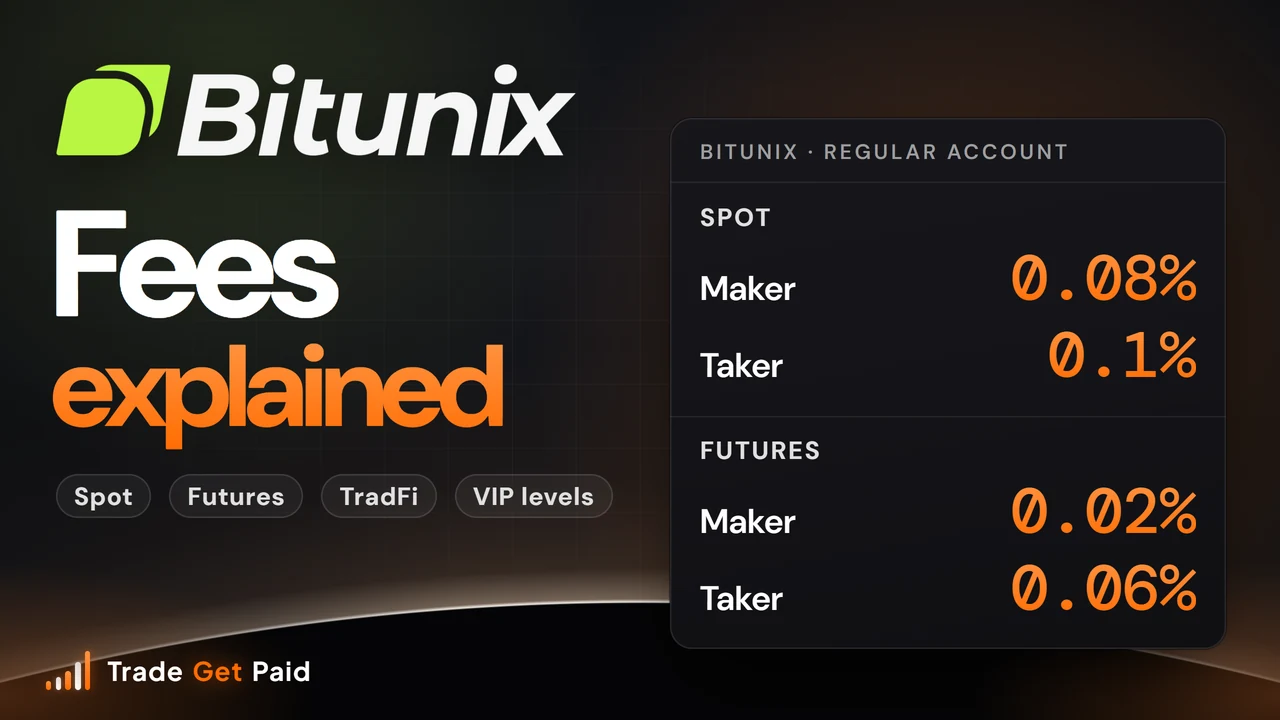
- Maker fees apply to limit orders that add liquidity to an exchange’s order book. Taker fees apply to market orders that remove liquidity.
- On futures, taker fees are higher at every exchange we list, because exchanges reward liquidity providers with lower rates. On spot the two are often the same until a VIP level.
- A limit order is not always a maker order. If its price lets it fill right away, it pays the taker fee. A post-only order prevents that.
- A market order costs more than its fee. It also pays the spread, and slippage when the order is big.
- The maker-taker model applies to both spot and futures markets, though futures fees tend to be significantly lower.
- Fee rebate platforms like TradeGetPaid can reduce your effective fees by up to 70%, turning a cost center into partial cashback.
Almost every trade on a crypto exchange comes with a fee. On most centralized platforms, that fee depends on whether your order adds liquidity to the order book or takes it away. That single distinction is the basis of the maker-taker fee model, which is the standard pricing structure on Binance, Kraken, Coinbase, and nearly every other major exchange.
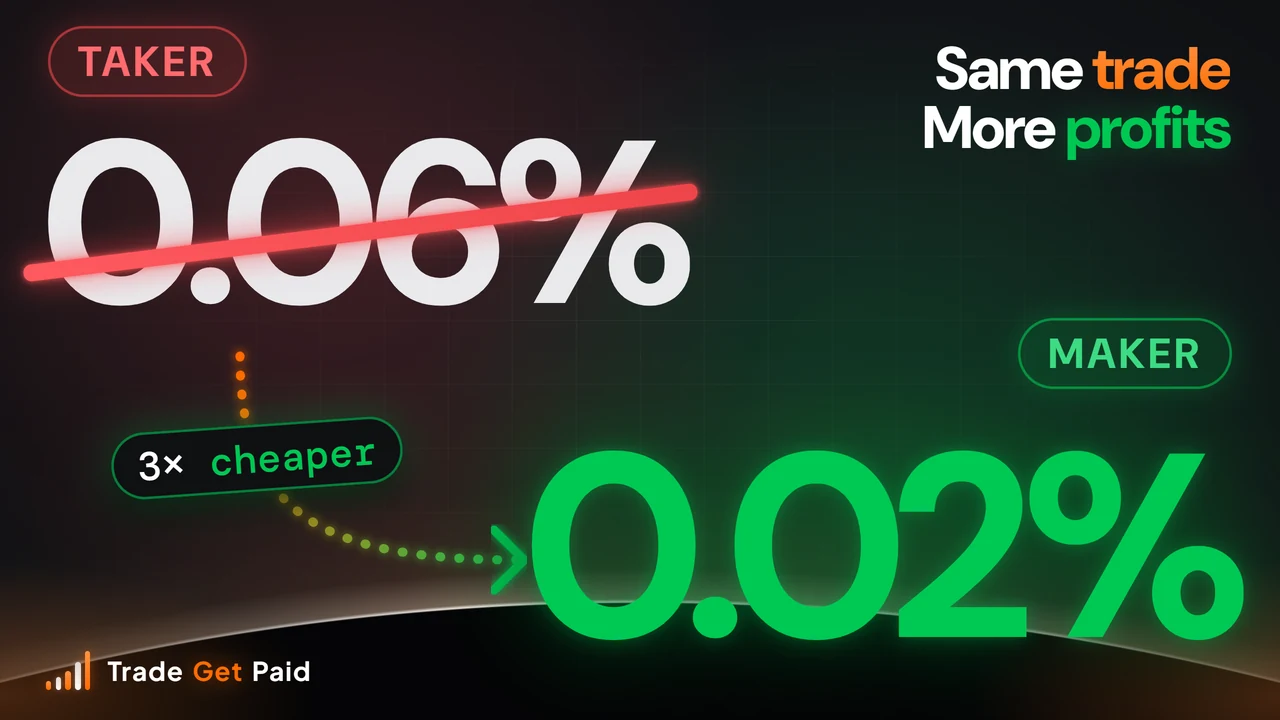 Play the video: Maker vs Taker Fees Explained with simple Examples
Watch this guide as a video (6:27).
Pressing play loads the video from YouTube. Privacy policy
The Order Book: Where Makers and Takers Meet
An exchange with maker and taker fees runs an order book: the list of everyone who wants to buy or sell a coin right now. Every order waiting on it is a limit order, an order to buy or sell at a price its owner set.
On one side are the buy orders, called bids. These are people waiting to buy at a certain price. On the other side are the sell orders, called asks. These are people waiting to sell. The gap between the highest bid and the lowest ask is the spread.
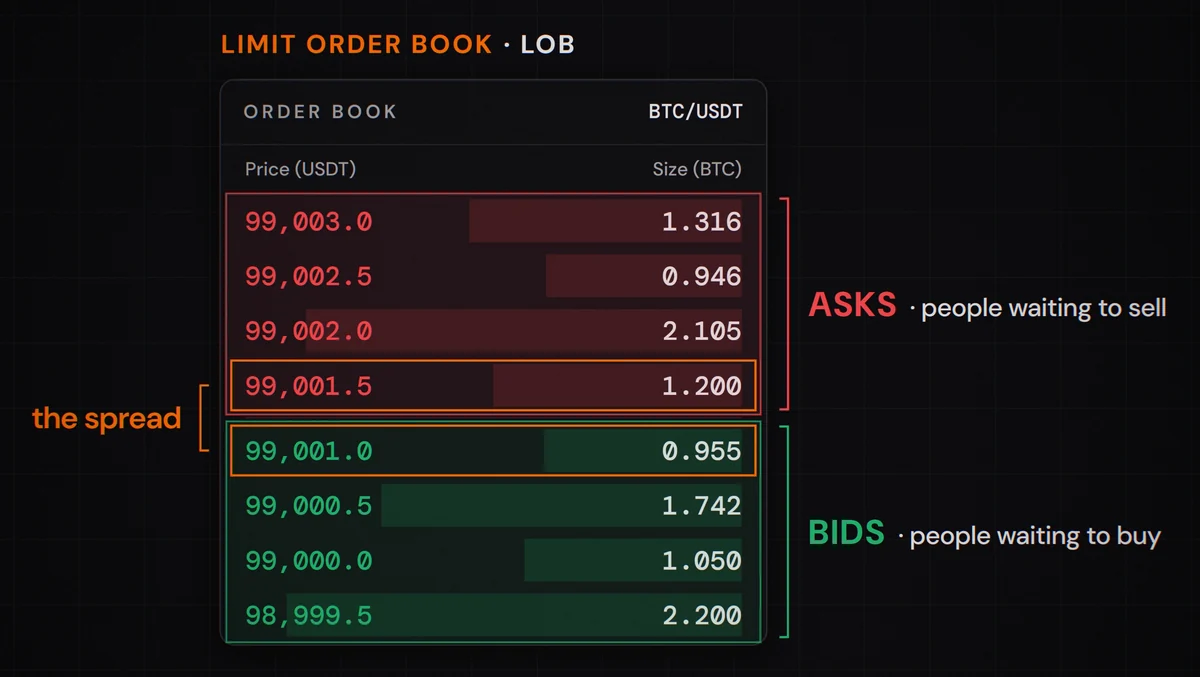
The order book: asks above, bids below, and the spread between the lowest ask and the highest bid.
All these waiting orders together are the market’s liquidity. Maker and taker fees come down to one question: does your order add liquidity to the book, or take it away?
What Is a Taker?
A taker places an order that fills immediately. Market orders are the most common example: you buy now, at the best price available. Your order is matched with an order that is already waiting on the book. Since it removes an existing offer from the book, it reduces liquidity, and you pay the taker fee.
Selling works the same way. A market sell is matched with the highest bids, so your coins turn back into money right away, and you pay the taker fee again.
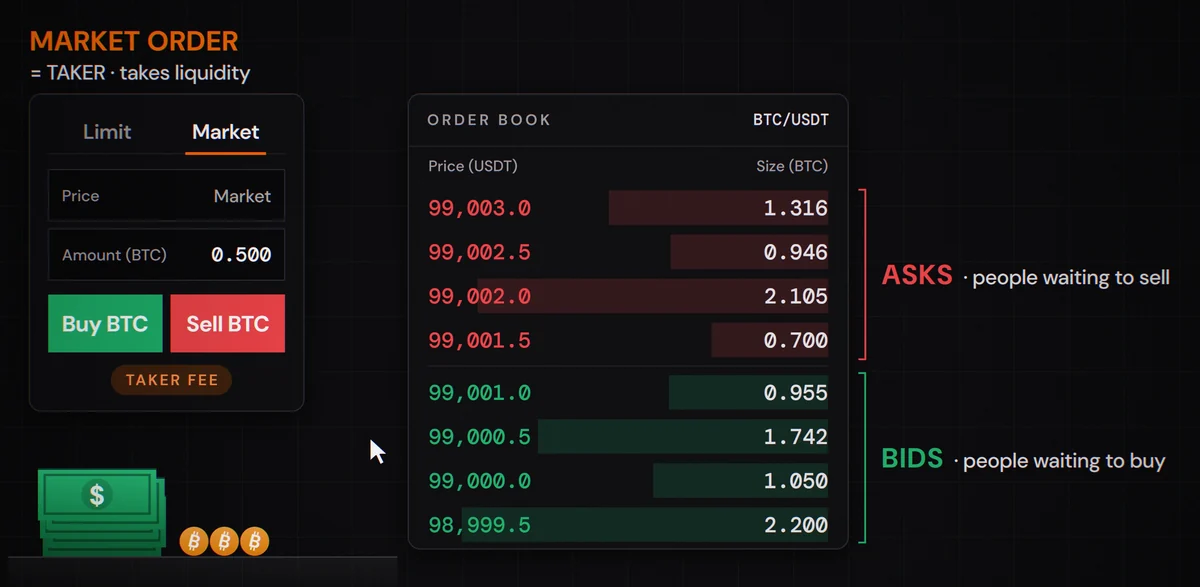
A market buy takes the lowest ask on the book. It fills at once and pays the taker fee.
That convenience costs more: on futures, taker fees are higher at every exchange we list.
What Is a Maker?
A maker is a trader who places an order that doesn’t execute right away. Usually this means a limit order set below the current ask (for buys) or above the current bid (for sells). The order sits on the book, waiting for someone to match it. That adds liquidity, and exchanges reward it with lower fees. On some platforms, makers actually receive a rebate, meaning the exchange pays them a small amount per trade.
Say Bitcoin trades around $99,001 and you place a limit order to buy at $99,000. Nobody is selling at that price yet, so your order joins the bids and waits. When a seller’s order reaches it, your order fills and you pay the maker fee.
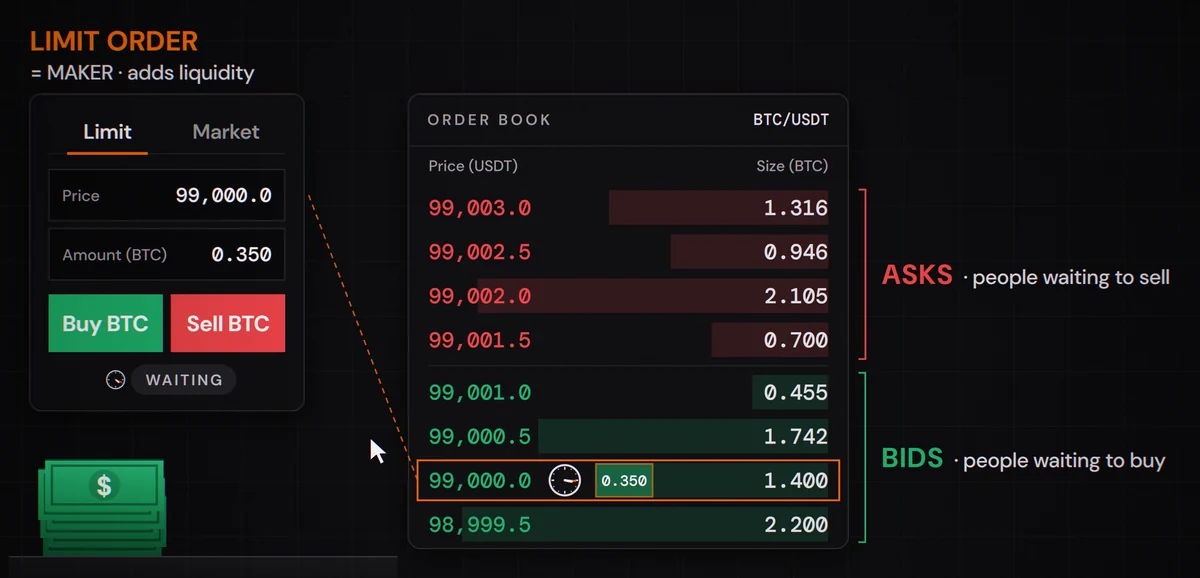
A limit buy below the market price waits on the book as a bid. When it fills, it pays the maker fee.
When a Limit Order Pays the Taker Fee
A limit order doesn’t always wait. If your buy price is at or above the lowest ask, there are already sellers at that price, so the order fills right away. It takes liquidity out of the book, just like a market order, and you pay the taker fee. A limit sell at or below the highest bid ends the same way.
This happens by accident when the price moves while you are placing the order. Blofin and WEEX both have an option against it: Blofin calls it Post Only, WEEX calls it Maker Only. An order placed this way can only trade as a maker. On Blofin, a Post Only order that would fill right away is cancelled instead, so you never pay the taker fee without meaning to.
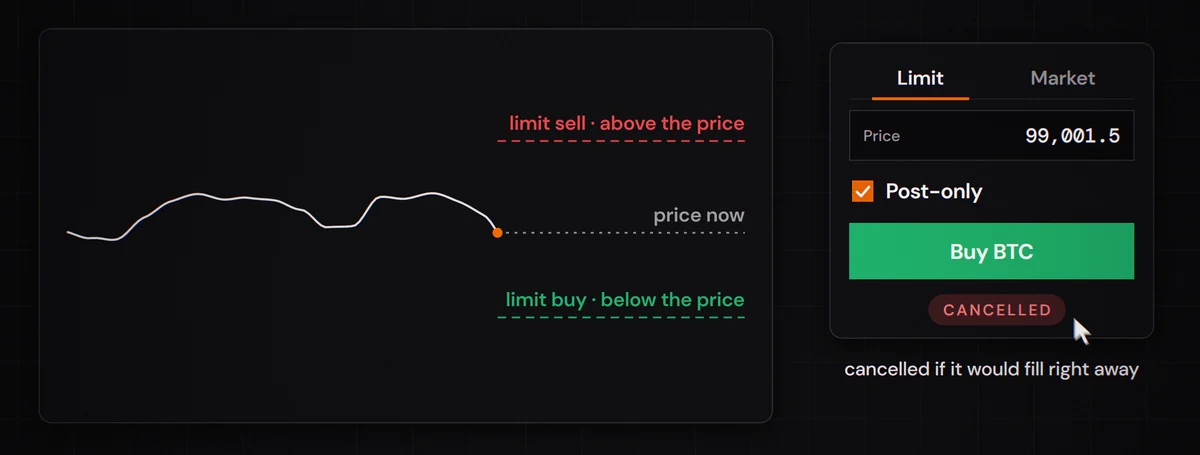
Post-only on the order form. On Blofin, an order that would fill right away is cancelled instead.
Why Are Taker Fees Higher?
Exchanges need deep order books. Without enough resting orders, spreads widen, slippage increases, and the trading experience suffers. Charging takers more and makers less creates a financial incentive that keeps the book populated. Tighter spreads and better price discovery benefit everyone on the platform.
Maker vs Taker Fees on Popular Exchanges
Fee rates vary widely. Below are the base-tier (non-VIP) rates for spot and futures on several exchanges as of 2026:
| Exchange | Spot Maker | Spot Taker | Futures Maker | Futures Taker | TGP Cashback |
|---|---|---|---|---|---|
| Bitunix | 0.08% | 0.10% | 0.02% | 0.06% | 70% |
| Blofin | 0.10% | 0.10% | 0.02% | 0.06% | 50% |
| XT.com | 0.20% | 0.20% | 0.02% | 0.06% | 45% |
| BingX | 0.10% | 0.10% | 0.02% | 0.05% | 40% |
| WEEX | 0.10% | 0.10% | 0.02% | 0.08% | 40% |
Rates shown are base-tier. VIP tiers and token discounts may reduce these further. On Bitunix and XT.com the cashback is on futures fees.
Spot Fees vs Futures Fees
Perpetual futures have a fee schedule of their own, and it is lower than spot. Futures maker fees on many exchanges sit at just 0.02%, compared to 0.08% to 0.20% on the spot side.
That gap adds up. A trader doing $100,000 in monthly futures volume at 0.06% taker pays $60 in fees. The same volume on spot at 0.10% costs $100.
What the Difference Costs on One Trade
Bitunix and Blofin both charge a regular futures account 0.02% as a maker and 0.06% as a taker. On a $10,000 position that is $2 as a maker or $6 as a taker.
You pay the fee when you open the position and again when you close it, so a full round trip costs $4 as a maker and $12 as a taker. Open and close 20 such positions in a month and the bill is $80 in maker fees or $240 in taker fees. That is $160 a month for the same trades, decided only by how the orders were placed.
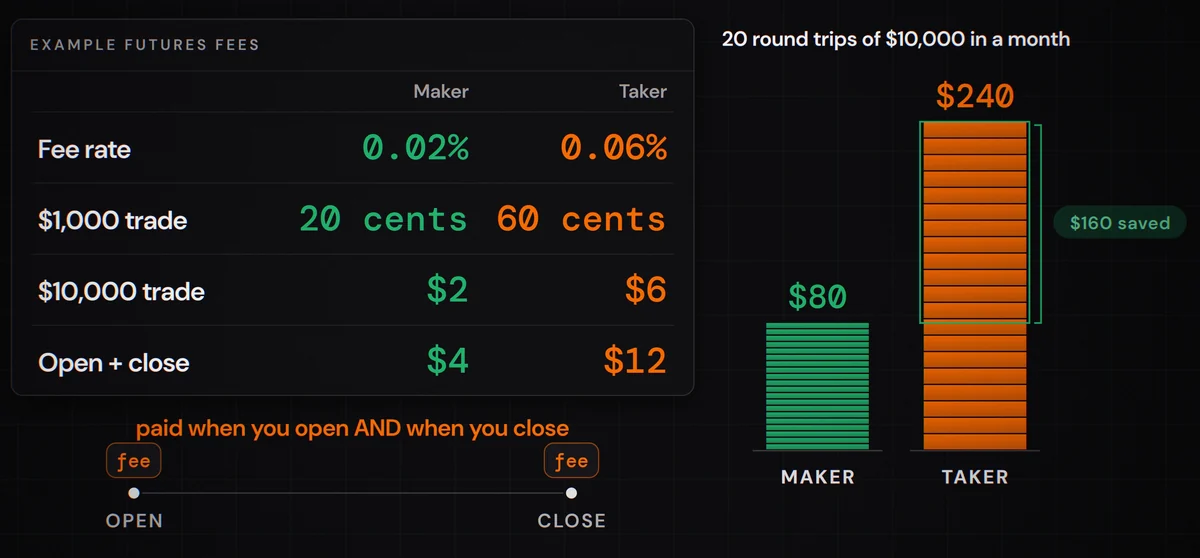
Twenty round trips of $10,000 in a month cost $80 in maker fees or $240 in taker fees.
How Fees Add Up: A Real Dollar Example
Say you trade futures on Blofin at the standard 0.06% taker rate. Here’s what you’d pay per month at different volume levels, and what you’d keep with TradeGetPaid’s 50% cashback:
| Monthly Volume | Fees Paid (0.06%) | TGP Cashback (50%) | Effective Cost |
|---|---|---|---|
| $50,000 | $30 | –$15 | $15 |
| $100,000 | $60 | –$30 | $30 |
| $500,000 | $300 | –$150 | $150 |
At $500K/month, that’s $1,800 saved per year just from routing through a rebate link. With Bitunix’s 70% cashback through TGP, the number climbs to $2,520 per year on the same volume.
The Other Costs of a Market Order: Spread and Slippage
The taker fee is not the only thing a market order costs.
The spread. A market buy fills at the lowest ask, and a market sell at the highest bid. Buy and sell right away and you lose the whole spread, before any fee.
Slippage. It appears when your order is bigger than what is waiting at the best price. Say you market buy 3 BTC while the lowest ask, $99,001.50, has only 0.7 BTC on it. Your order takes those 0.7 BTC, then 2.105 BTC at $99,002, and the last 0.195 BTC at $99,002.50. Your 3 BTC cost $99,001.92 each on average, not the $99,001.50 you saw. That difference is slippage.
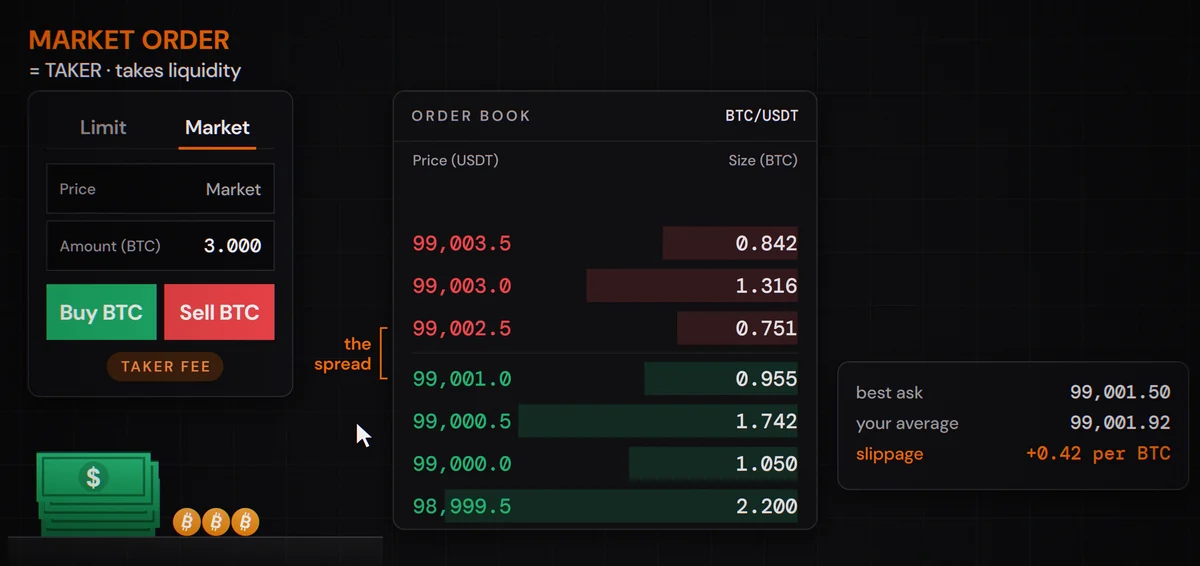
A 3 BTC market buy empties the lowest ask and fills the rest at higher prices. The average price ends up above the price you saw.
The spread is there on every market order, slippage only on bigger ones. Both shrink with liquidity: a busy market has a tight spread and little slippage, a thinly traded coin has more of both. A limit order protects you from both: it only fills at your price or better.
Market Order or Limit Order: Which One to Use
Both have their place.
| Market order | Limit order | |
|---|---|---|
| Fee | Taker | Maker, when it waits on the book |
| Fills | Right away | Only if the price comes to you |
| Price | The best available, with spread and slippage | Your price or better |
| The cost | The higher fee on futures | You can miss the trade |
Use a limit order when the trade can wait, and a market order when getting filled now matters more than the fee.
How to Reduce Your Maker and Taker Fees
- Use limit orders when possible. If your trade isn’t time-sensitive, placing a limit order away from the market price qualifies you for the lower maker fee.
- Increase your volume tier. Most exchanges reduce fees as your 30-day volume grows. Check your exchange’s VIP schedule to see where you stand.
- Pay fees in the exchange’s token. Some exchanges give a discount for it: XT.com takes 25% off spot fees when you pay them in its XT token.
- Use a cashback platform. Services like TradeGetPaid return a percentage of the trading fees you pay, maker or taker, as automatic cashback. This stacks on top of VIP discounts.
Start Earning Back Your Trading Fees
Now that you know how maker and taker fees work, make sure you’re not overpaying. TradeGetPaid partners with exchanges like Bitunix, Blofin, BingX, and others to automatically return up to 70% of your trading fees as cashback. Nothing changes about how you trade. No minimums, no hoops. Start for free at TradeGetPaid and start getting paid back on every trade.
Frequently Asked Questions
For fees, a maker: on futures the maker rate is lower at every exchange we list. A taker gets speed instead. The order fills at once, where a maker’s order fills only if the price comes to it.
No. A limit order that can fill right away, such as a buy at or above the lowest ask, pays the taker fee. A post-only order prevents it: it can only trade as a maker.
No. Each order pays one of the two, depending on how it fills. Open a position with a limit order that waits on the book and close it with a market order, and you pay the maker fee once and the taker fee once.
Yes. Futures have their own maker and taker rates, and they are charged on the whole position, not on your margin. With 10x leverage, $1,000 of margin pays fees on $10,000.
Yes. Open your exchange account through TradeGetPaid and part of the trading fees you pay comes back as cashback, up to 70%, whether you were the maker or the taker. On Bitunix and XT.com the cashback is on futures fees.