- Futures fees are charged on the whole position, not on your margin. With 10x leverage, $1,000 of your own money pays fees on $10,000.
- A round trip at a 0.06% taker fee costs 0.12% of the position. The price has to move that far in your favour before the trade makes anything.
- Fees compound. Each fee leaves a slightly smaller account for the next trade, and over a hundred trades the gap gets large.
- Cashback returns part of every fee after the trade, up to 70% through TradeGetPaid. It lands in your exchange account.
- Cashback lowers your costs, but it can’t fix a strategy. A losing trade still loses, and trading more just to collect cashback costs more than it returns.
What a trading fee costs on a leveraged trade
Futures exchanges charge the fee on the size of the position you open, not on the money you put in. Open a $10,000 position with $1,000 of your own money at 10x leverage, and Bitunix’s regular taker fee of 0.06% costs $6 to open and another $6 to close.
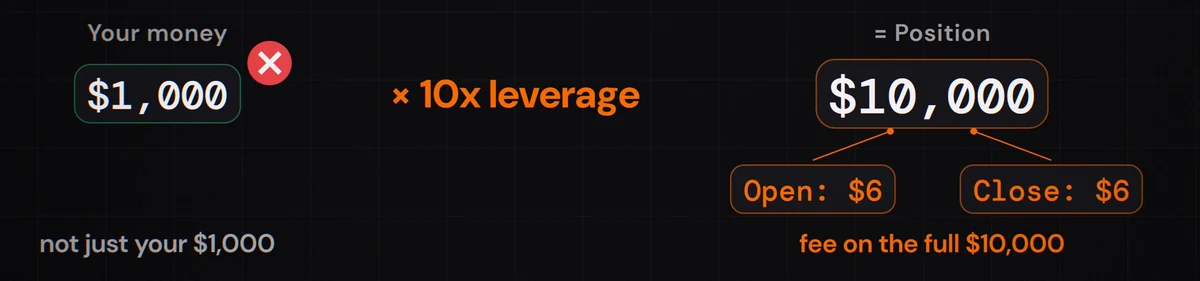
At 10x leverage, $1,000 of margin opens a $10,000 position, and the fee is charged on all of it.
That $12 round trip is 1.2% of your $1,000. Make twenty trades like it in a month and the fees come to $240, about a quarter of the account, whether the trades win or lose.
The price move you need to break even
A trade only starts making money once the price has moved far enough to pay both fees. With a 0.06% taker fee to open and another to close, that is a 0.12% move in your favour. When 70% of the fees come back as cashback, the cost drops to 0.036%, and so does the move you need.
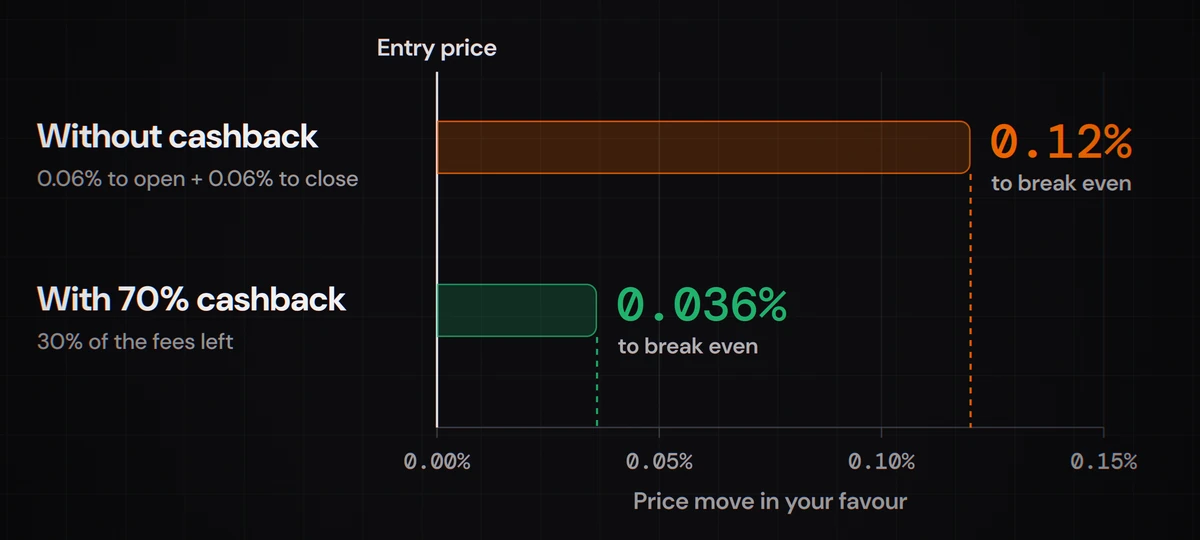
Two taker fees of 0.06% need a 0.12% price move to break even. With 70% cashback, 0.036% is enough.
The difference matters most to traders who aim for small moves. A strategy that targets 0.2% per trade hands more than half of it to fees at 0.12%, and less than a fifth at 0.036%.
How fees compound over many trades
Every fee leaves the account a little smaller, so the next trade is a little smaller and earns a little less. Over many trades, that adds up to far more than the fees themselves.
The chart follows two traders through the same 100 trades. Both start with $10,000, use 5x leverage, win 1.5% of the account on every trade before fees, and pay the taker fee to open and to close. One of them gets cashback after every trade. Choose an exchange to see its result.
Profit Comparison
 Bitunix70% cashback
 Bitbase70% cashback
 KCEX50% cashback
 BTCC50% cashback
 Blofin50% cashback
 BYDFi50% cashback
 Ourbit45% cashback
 XT.com45% cashback
 BingX40% cashback
 WEEX40% cashback
 MEXC20% cashback
+$12,615 more profit from the same trades
$10,000 start · 5x leverage · +1.5% per trade before fees · 0.06% taker fee to open and to close · Bitunix 70% cashback
With Bitunix’s fees, the trader without cashback ends at about $24,500 and the trader with 70% cashback at about $37,100. Had the same trades paid no fees at all, the account would have grown to about $44,300. For the trader without cashback, fees took more than half of what the trades made.
Real trading includes losing trades, and they pay the same fees. The chart shows how costs add up over time. It is not a forecast of returns.
Ways to pay less in fees
- Use limit orders when you can wait. An order that waits on the order book pays the maker fee, which is the lower one on futures. On Bitunix a maker pays 0.02% and a taker 0.06%. Our maker vs taker guide explains when a limit order still pays the taker fee.
- Pick an exchange with low fees. Among the exchanges we list, the regular futures taker fee runs from 0.01% on KCEX to 0.08% on WEEX.
- Reach a VIP level. Exchanges lower their fees for accounts with more trading volume or larger balances. Where the levels start differs a lot from one exchange to the next.
- Get cashback on the fees you still pay. It works together with all of the above.
How to reduce your trading fees goes through each of these in more detail.
How trading cashback works
Exchanges pay a commission to the partners who bring them traders, and the commission comes out of those traders’ fees. A cashback service is a partner that passes most of its commission back to the traders.
With TradeGetPaid, you open your exchange account through our link, and the exchange links the account to us. After that you trade as usual and pay the exchange’s normal fees. The exchange pays us a commission out of those fees, and we pass most of it back to you as cashback. It lands in your exchange account, usually within 24 hours. There is nothing to claim and no minimum. Using TradeGetPaid is free, and we keep a small part of the commission.
You pay the fee, the exchange pays us a commission, and we pass most of it back to you.
The rate is a share of the fees you pay. At 70% cashback, a $12 fee brings back $8.40, which turns Bitunix’s 0.06% taker fee into an effective 0.018%. The rate is the same at every VIP level, and a losing trade earns cashback like a winning one, because it pays the same fees.
What the rate covers depends on the exchange. On Bitunix and XT.com it covers futures fees only. On the other exchanges we list it covers spot fees as well.
Fees after cashback on the exchanges we list
These are the regular futures fees on each exchange we list, before and after cashback, with the lowest fee after cashback first.
| # | Exchange | Cashback | Base Fee (maker / taker) | TGP Fee (maker / taker) |
|---|---|---|---|---|
| 1 | KCEX | 50% | 0.00% / 0.01% | 0.000% / 0.005% |
| 2 | MEXC | 20% | 0.00% / 0.02% | 0.000% / 0.016% |
| 3 | Bitunix | 70% | 0.02% / 0.06% | 0.006% / 0.018% |
| 4 | Bitbase | 70% | 0.02% / 0.06% | 0.006% / 0.018% |
| 5 | Ourbit | 45% | 0.02% / 0.04% | 0.011% / 0.022% |
| 6 | BTCC | 50% | 0.03% / 0.055% | 0.015% / 0.0275% |
| 7 | Blofin | 50% | 0.02% / 0.06% | 0.010% / 0.030% |
| 8 | BYDFi | 50% | 0.02% / 0.06% | 0.010% / 0.030% |
| 9 | BingX | 40% | 0.02% / 0.05% | 0.012% / 0.030% |
| 10 | XT.com | 45% | 0.02% / 0.06% | 0.011% / 0.033% |
| 11 | WEEX | 40% | 0.02% / 0.08% | 0.012% / 0.048% |
Our ranking of the cheapest futures fees compares them in more detail.
What cashback can’t do
- It can’t turn a losing trade into a winning one. It lowers what trading costs you. Whether a trade wins is still down to the market and to you.
- Trading more to earn more cashback loses money. At 70% cashback you still pay 30% of every fee, so every extra trade costs you something.
- It has to be in place before you trade. The exchange links your account to TradeGetPaid when you sign up through our link. An account you opened before usually can’t be added later.
- Funding payments aren’t trading fees. On perpetual futures they go between traders, not to the exchange, so there is no cashback on them.
Getting cashback on your trading fees
Pick an exchange on our exchanges page and open your account through its sign-up link. The cashback starts with your first trade.
Frequently asked questions
No. You pay the exchange’s normal fees, as you would without us, and part of them comes back. TradeGetPaid has no subscription or fee of its own.
Usually not. The exchange links an account to TradeGetPaid when it is opened through our link. On most exchanges that means opening a new account.
Usually within 24 hours, although timing can vary by exchange. It goes straight to your exchange account, where you can trade with it or withdraw it like any other funds.
No. The rate is the same at every VIP level. A higher level lowers the fee itself, so the same rate gives back less in dollars.
Yes. Cashback is a share of the fees you pay, and a losing trade pays its fees like any other.