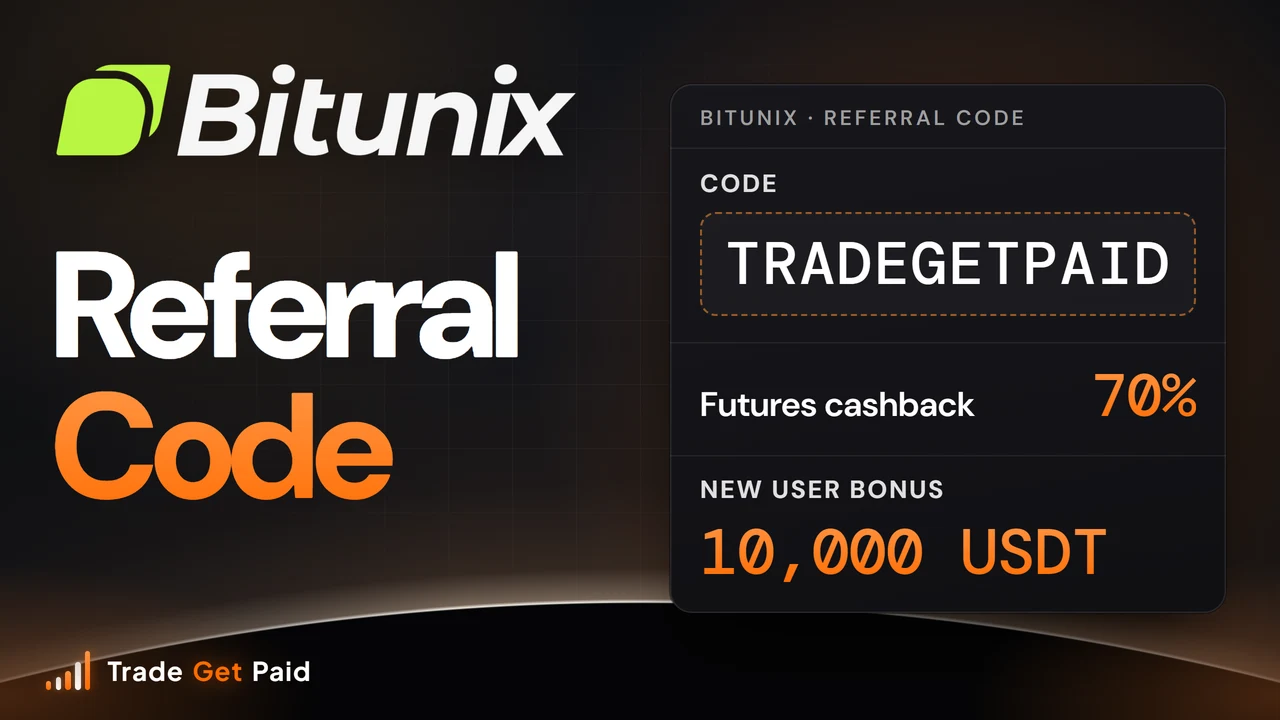
- Futures: a regular account pays 0.02% as a maker and 0.06% as a taker.
- Spot: 0.08% maker and 0.10% taker.
- Futures fees are charged on the whole position, not on your margin, and you pay them when you open and again when you close.
- VIP levels cut both rates. You only need to meet one condition per level, and VIP 1 starts at 300 USDT in assets.
- Funding is paid between traders, usually every 8 hours, and only if your position is open at that moment.
- With TradeGetPaid you get 70% of your futures trading fees back, which takes the futures rates to 0.006% maker and 0.018% taker.
Bitunix fees at a glance
| Fee | Maker | Taker |
|---|---|---|
| Spot | 0.08% | 0.10% |
| Futures | 0.02% | 0.06% |
| TradFi (stocks, ETFs, indices, commodities) | 0.02% | 0.06% |
| Convert | No fee | No fee |
Rates for a regular account (VIP 0). Higher VIP levels pay less. On top of the trading fee, futures and TradFi positions pay or receive funding at set times, between traders rather than to Bitunix. Convert has no fee, but its cost is built into the price it quotes.
If you’d rather watch than read, we also have a video guide on Bitunix fees.
 Play the video: Bitunix Fees Explained (Spot, Futures, VIP Levels) And How To Reduce your Bitunix Fees by 70%
Bitunix fees explained (5:20).
Pressing play loads the video from YouTube. Privacy policy
Maker or taker: which fee you pay
A market order fills immediately against orders already waiting in the order book. It takes liquidity out of the order book, so you pay the taker fee.
A limit order that sits in the order book until someone else trades against it adds liquidity, so you pay the lower maker fee.
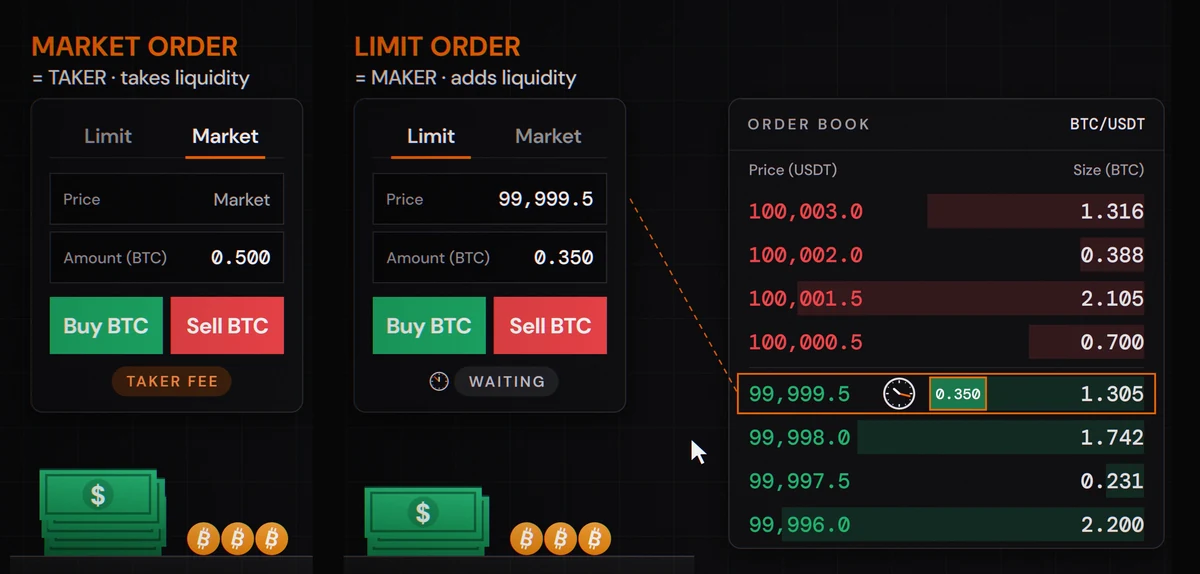
Market orders fill right away and pay the taker fee. Limit orders that wait on the book pay the maker fee.
There’s one catch. A limit order priced so that it fills immediately counts as a taker order too. If you set a buy limit above the current ask, it matches right away and you’re charged the taker rate. Our maker vs taker guide explains this in more detail.
Bitunix spot fees
On spot you buy the coin itself, and it’s yours to hold or withdraw. A regular account pays 0.08% as a maker and 0.10% as a taker.
Buy $1,000 of Bitcoin with a market order and the fee is $1.00. Place the same buy as a limit order that waits in the book and it drops to $0.80. Selling later costs the same again, so a full round trip on $1,000 comes to about $2.
If you only want to swap one coin for another, Bitunix Convert charges no trading fee. You’re quoted a price instead, and that quote can be a little worse than the spot market, so the cost is built into the rate you get.
Bitunix futures fees
Futures on Bitunix are perpetual contracts. You don’t own the coin, you hold a contract that follows its price, and you can go long if you expect the price to rise or short if you expect it to fall. You can also use leverage, up to 200x on BTC and ETH, which means trading a bigger position than the money you put in.
A regular account pays 0.02% as a maker and 0.06% as a taker. The rates are lower than on spot, but what you actually pay often isn’t, because of leverage.
Why leverage makes futures fees bigger
Bitunix charges futures fees on the size of your position, not on the margin you put up. Say you deposit $1,000 and open a trade with 10x leverage. Your position is now worth $10,000, and that’s the number the fee is calculated on.
With market orders, opening that position costs $6 and closing it costs another $6. That’s $12 in fees, or 1.2% of your own $1,000, before the price has moved at all. The same trade with a $1,000 spot buy and sell would cost about $2.
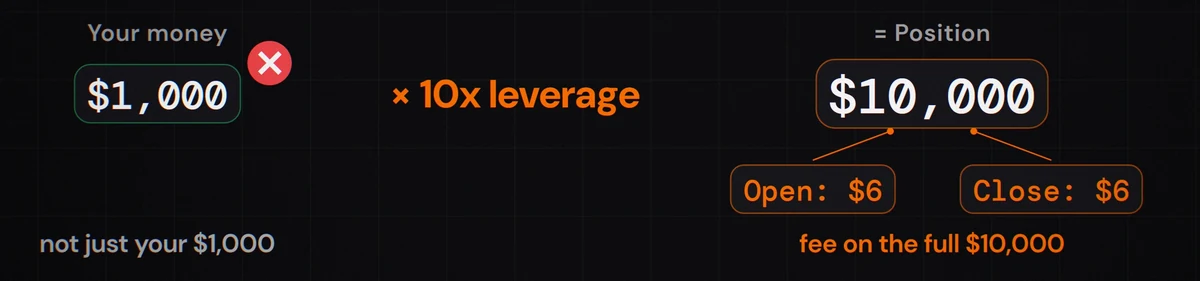
At 10x leverage, $1,000 of margin opens a $10,000 position, and each side costs $6 at the regular taker rate.
Use limit orders on both sides and the same round trip costs $4 instead of $12. Ten trades like that in a month cost $120 with market orders and $40 with limit orders.
How Bitunix calculates it
The fee for each side is the price, times the position size, times your fee rate. Opening and closing are charged separately, and each uses the price at that moment. Bitunix’s own example uses 0.1 BTC opened at 20,000 USDT and closed at 21,000 USDT. At the regular taker rate that’s 1.20 USDT to open and 1.26 USDT to close, 2.46 USDT in total. The closing fee is slightly higher because the position is worth more by then.
Funding fees on perpetual futures
Perpetual contracts never expire, so exchanges use funding payments to keep the contract price close to the spot price. These payments go between traders, from longs to shorts or the other way round, and they’re separate from the trading fee.
Funding changes hands between longs and shorts, usually every 8 hours.
- Who pays: when the funding rate is positive, longs pay shorts. When it’s negative, shorts pay longs.
- When: usually every 8 hours, at 00:00, 08:00 and 16:00 UTC. Some pairs settle more often, every 4 hours or even every hour, so check the pair’s info page before you hold a position for long.
- How much: your position value times the funding rate. At a rate of 0.01%, a $10,000 position pays or receives $1 per settlement.
- Only at settlement: if you close before the funding time, you don’t pay or receive anything. Bitunix allows about 15 seconds of deviation, so a position opened a few seconds after the hour can still be charged.
Funding rates move with the market and can be much higher than 0.01% when one side is crowded. If you hold positions for days, funding can end up costing more than the trading fees, so it’s worth watching the rate shown on the trading page.
Bitunix VIP levels
Bitunix has nine levels, from VIP 0 to VIP 8. Your level applies to spot and futures at the same time, so trading volume on futures also lowers your spot fees.
| Level | Spot maker | Spot taker | Futures maker | Futures taker |
|---|---|---|---|---|
| VIP 0 | 0.0800% | 0.1000% | 0.0200% | 0.0600% |
| VIP 1 | 0.0700% | 0.0900% | 0.0200% | 0.0500% |
| VIP 2 | 0.0600% | 0.0800% | 0.0160% | 0.0500% |
| VIP 3 | 0.0350% | 0.0600% | 0.0140% | 0.0400% |
| VIP 4 | 0.0200% | 0.0500% | 0.0120% | 0.0375% |
| VIP 5 | 0.0150% | 0.0450% | 0.0100% | 0.0350% |
| VIP 6 | 0.0125% | 0.0375% | 0.0080% | 0.0315% |
| VIP 7 | 0.0100% | 0.0325% | 0.0060% | 0.0300% |
| VIP 8 | 0.0048% | 0.0180% | 0.0000% | 0.0260% |
Rates from Bitunix’s fee page, checked 8 October 2026.
At VIP 1 the futures maker fee stays at 0.02% and only the taker fee drops. At VIP 8, futures makers pay nothing at all.
How to reach each level
You need to meet just one of three conditions: 30-day spot volume, 30-day futures volume, or the value of the assets in your account.
| Level | 30-day futures volume | 30-day spot volume | Assets |
|---|---|---|---|
| VIP 1 | 1,000,000 USDT | 100,000 USDT | 300 USDT |
| VIP 2 | 5,000,000 USDT | 500,000 USDT | 5,000 USDT |
| VIP 3 | 8,000,000 USDT | 800,000 USDT | 25,000 USDT |
| VIP 4 | 20,000,000 USDT | 2,000,000 USDT | 140,000 USDT |
| VIP 5 | 50,000,000 USDT | 4,000,000 USDT | 700,000 USDT |
| VIP 6 | 100,000,000 USDT | 6,000,000 USDT | 1,400,000 USDT |
| VIP 7 | 200,000,000 USDT | 8,000,000 USDT | 2,400,000 USDT |
| VIP 8 | 500,000,000 USDT | 100,000,000 USDT | Not available |
The asset route is the easy one for smaller accounts. Holding 300 USDT is enough for VIP 1, which cuts the futures taker fee from 0.06% to 0.05% and trims spot fees too.
Some rules decide whether a level sticks:
- API trading doesn’t count toward VIP volume, and neither does volume whose fees were covered by a fee discount voucher. From VIP 4 up, API trades must stay under 10% of your total volume.
- New levels are locked for 90 days. After an upgrade, Bitunix keeps your level for 90 days, then checks your volume and assets again. You only drop if none of the three conditions still meets your level.
- You can bring a VIP level from another exchange. Bitunix offers a level one step above your VIP status elsewhere, for example on Binance, OKX, BingX or Bitget. You apply through the VIP program page, or by emailing your Bitunix UID and a screenshot of your 30-day volume to vip@bitunix.com. It starts as a trial pass.
Other costs to know about
- Guaranteed stop loss: an optional stop that fills at your exact price, available on BTC, ETH, SOL and XRP futures. It costs a small extra fee (0.025% of the order value on BTCUSDT at the time of writing), and only if the stop actually triggers.
- Copy trading: no extra platform fee. Copied trades pay normal futures fees, and the trader you follow takes a share of your profit, 10% by default.
- Deposits and withdrawals: withdrawals carry a network fee that depends on the coin and the chain. Bitunix lists them on the Deposit/Withdraw tab of its fee page.
How to pay less on Bitunix
Bitunix has no fee token discount and no negative maker fees, so the ways to cut costs are fairly simple.
- Use limit orders when you’re not in a hurry. On futures, the maker fee is a third of the taker fee. On the $10,000 example above, that’s $2 per side instead of $6.
- Reach VIP 1 if it’s cheap for you. If you already hold 300 USDT on the exchange, you qualify without trading more.
- Check funding before holding positions for days. A crowded trade can cost more in funding than in trading fees.
- Watch your leverage. Fees scale with position size, so 20x leverage costs twice as much in fees as 10x on the same margin.
- Use vouchers from events. Bitunix hands out futures fee discount vouchers and futures bonuses during promotions. Both can cover part of your fees, but they expire.
- Get part of your fees back through a cashback site, covered in the next section.
Bitunix fees after cashback
Exchanges pay a share of your trading fees to whoever referred you. Cashback sites like TradeGetPaid pass most of that share back to you. On Bitunix, TradeGetPaid returns 70% of your futures trading fees. Spot fees aren’t included. You pay Bitunix its normal fees, and you get part of them back afterwards.
On futures, that brings the regular maker fee down to an effective 0.006% and the taker fee to 0.018%. The $10,000 market order from earlier still costs $6 to open, but $4.20 of it comes back, so the real cost is $1.80. That’s lower than the VIP 8 taker rate.
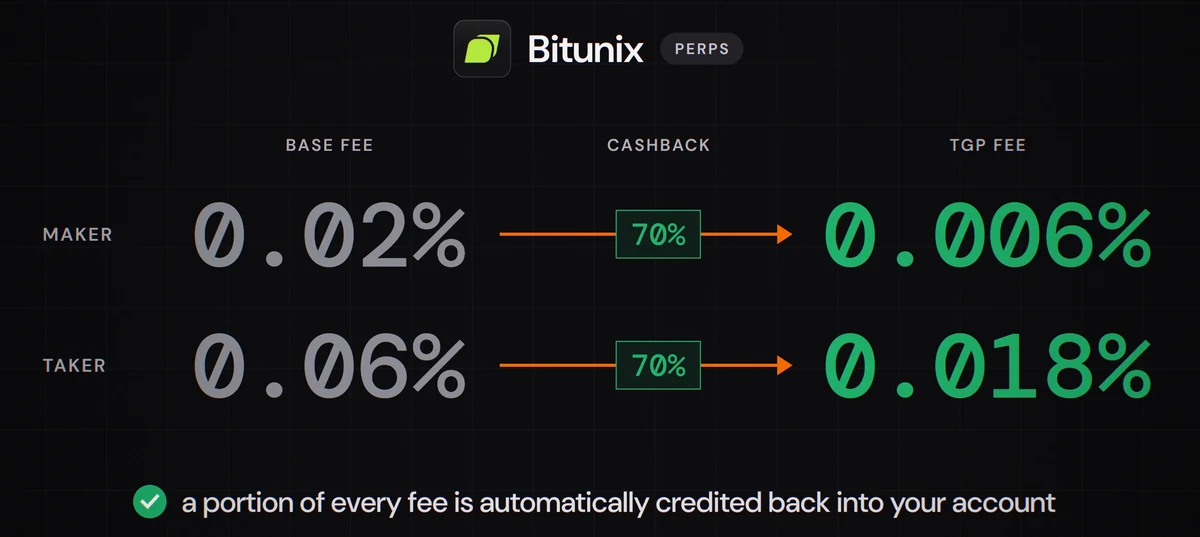
Regular Bitunix futures rates before and after 70% cashback.
Here’s what that looks like over a month of futures trading with taker orders at the regular rate:
| Monthly futures volume | Fees at 0.06% | 70% back | What you really pay |
|---|---|---|---|
| $50,000 | $30 | $21 | $9 |
| $250,000 | $150 | $105 | $45 |
| $1,000,000 | $600 | $420 | $180 |
One thing to keep in mind: when you pay fees with a Bitunix futures bonus, Bitunix pays no referral commission on the part covered by the bonus. That part earns no cashback either.
Start trading on Bitunix with lower fees
Sign up through TradeGetPaid and 70% of your Bitunix futures fees are paid back to you automatically.
Fees change, so check your own rate on Bitunix’s fee page before you trade. Official sources: fee schedule, VIP program, futures fee calculation, funding rate, VIP FAQ.
Frequently asked questions
A regular account pays 0.08% maker and 0.10% taker on spot, and 0.02% maker and 0.06% taker on futures. Higher VIP levels pay less.
The rates are lower, but futures fees are charged on the full position. With 10x leverage, a futures trade on $1,000 of margin pays fees on $10,000, so the total is often higher than a spot trade with the same money.
Yes. Each side is charged separately, at the maker or taker rate that applies to that order.
Usually every 8 hours, at 00:00, 08:00 and 16:00 UTC. Some pairs settle every 4 hours or every hour. You only pay or receive funding if your position is open at settlement.
Meet any one of these: 300 USDT in assets, 1,000,000 USDT in 30-day futures volume, or 100,000 USDT in 30-day spot volume.
No. You lower fees through VIP levels, limit orders, event vouchers and cashback.