- Spot: a regular account pays 0.00% as a maker and 0.00% as a taker, on every spot pair, with no end date announced.
- Futures: 0.00% for makers and 0.01% for takers, worked out on the full position each time you open or close. A limit order that waits on the book pays nothing.
- Stock, gold and oil futures pay the same rates as crypto futures.
- Funding passes between longs and shorts, usually every 8 hours, and KCEX keeps none of it. Only positions still open at funding time take part.
- No VIP levels: KCEX publishes one set of rates, whatever your volume or balance.
- With TradeGetPaid you get 50% of your trading fees back. That takes the futures taker rate, the only regular rate above zero, to an effective 0.005%.
KCEX fees at a glance
| Fee | Maker | Taker |
|---|---|---|
| Spot | 0.00% | 0.00% |
| Futures (USDT and USDC perpetuals) | 0.00% | 0.01% |
| TradFi futures (stocks, ETFs, gold, oil) | 0.00% | 0.01% |
Rates for a regular account. KCEX has no VIP levels and publishes no lower rates for bigger traders. A zero-fee promotion on meme coin futures runs until 16:00 UTC on 24 March 2027, and the order form shows each pair’s own rate. Futures positions also pay or receive funding at set times. Longs and shorts pay it to each other, and KCEX keeps none of it.
If you’d rather watch than read, we also have a video guide on KCEX fees.
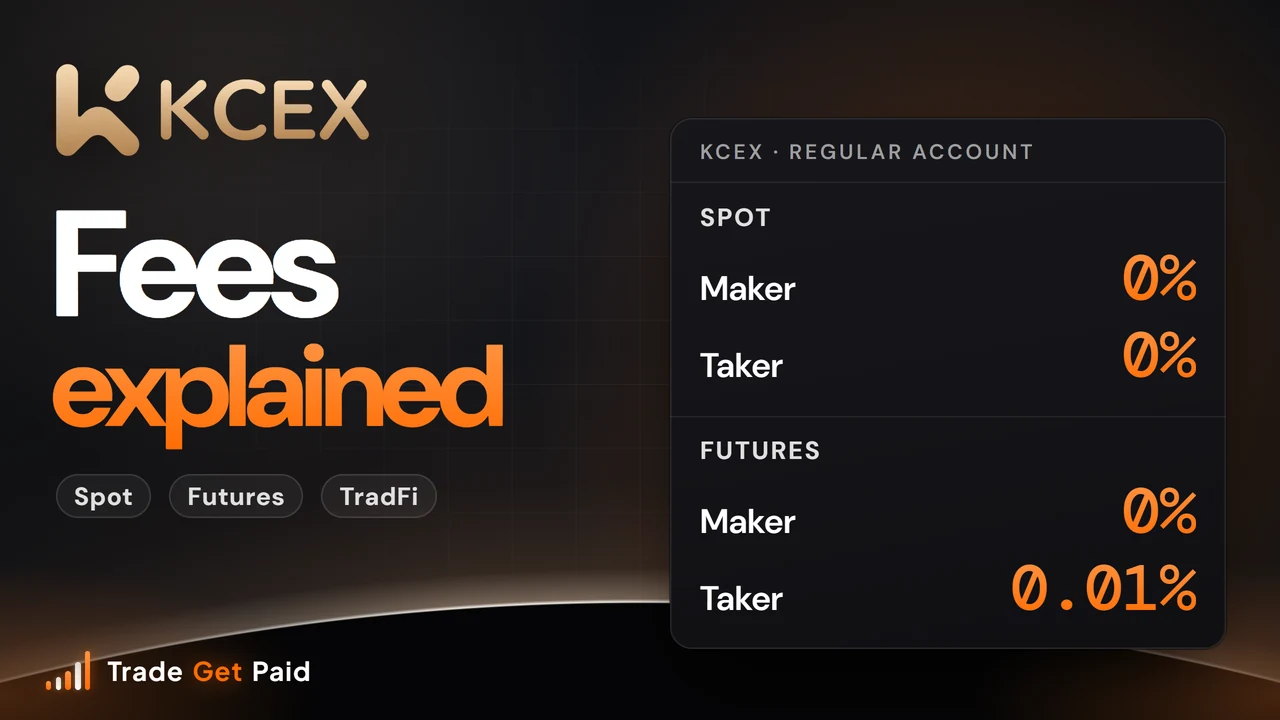 Play the video: KCEX Fees Explained (Spot, Futures, TradFi) And How To Reduce your KCEX Fees by 50%
KCEX fees explained (4:34).
Pressing play loads the video from YouTube. Privacy policy
Maker or taker: which fee you pay
On KCEX spot both rates are 0.00%, so maker and taker only matter on futures.
A market order fills immediately against orders already waiting in the order book. It takes liquidity out of the order book, so you pay the taker fee.
Place a limit order to buy below the current price and it waits in the order book. KCEX calls that a maker order, one that “remains on the order book awaiting execution, thereby adding liquidity to the market”. Once a seller trades against it, you pay the maker fee.
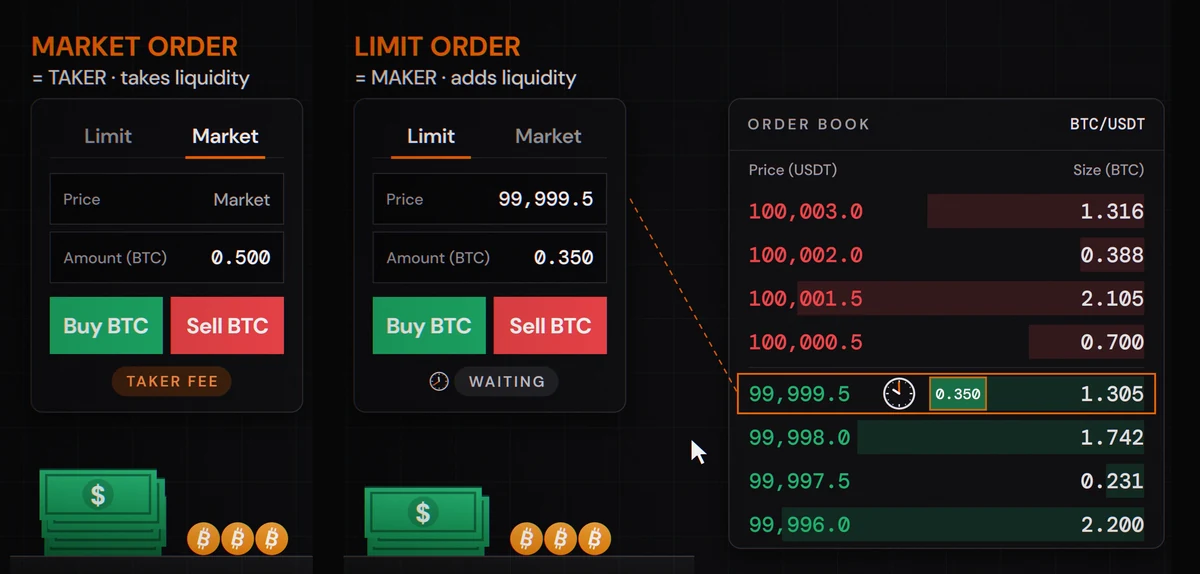
A market order takes liquidity and pays the taker fee, 0.01% on KCEX futures. A limit order that waits on the book adds liquidity and pays the maker fee, 0.00%.
Price a limit order so that it matches the book straight away, and KCEX treats it as a taker. If only part of it fills at once, KCEX charges that part at the taker rate and the rest at the maker rate once it fills from the book. Our maker vs taker guide compares the two fees on other exchanges too.
KCEX spot fees
A spot trade buys or sells the coin itself. A regular account currently pays 0.00% as a maker and 0.00% as a taker on every spot pair, so the order type makes no difference to the fee.
Buy $1,000 of Bitcoin and the fee is $0. Sell it later and that’s free too, so the round trip costs nothing in trading fees.
On other big exchanges the same trade has a fee. Binance and Bybit charge a regular account 0.1% as a maker and as a taker, so the $1,000 buy costs $1 there and the round trip $2. For a new account, Kraken Pro’s spot rates are 0.4% maker and 0.8% taker, and Coinbase Exchange’s are 0.4% and 0.6%: a $1,000 market buy costs $8 or $6 there.
KCEX first set spot fees to zero in a promotion that began on 14 April 2024, replacing a rate of 0.1% on both sides. Its fee calculator now calls zero a standard rate, not a limited-time promotion, while its spot FAQ still describes a zero-fee event. KCEX hasn’t set an end date, and it says any change to its fees will be announced in advance.
KCEX futures fees
Every futures contract on KCEX is a perpetual, margined in either USDT or USDC. You hold a contract that tracks a coin’s price rather than the coin, so there’s nothing to withdraw. You can go long or short and use leverage: up to 125x on BTCUSDT, with lower limits on bigger positions and on some other pairs.
Both USDT and USDC contracts charge a regular account 0.00% as a maker and 0.01% as a taker. Unlike spot, futures cost something when you take liquidity, and leverage decides how much.
Why leverage makes futures fees bigger
KCEX works out a futures fee as “Executed Quantity × Execution Price × Trading Fee Rate”. Quantity times price is the value of the whole position, so the fee follows the position, not the margin you put up. KCEX’s fee calculator puts it in numbers: “For a notional position of 10,000 USDT, a Maker fill costs 0, while a Taker fill costs 1 USDT.”
Put in $1,000 of your own money at 10x leverage and you hold a $10,000 position, so the fee is worked out on $10,000. A market order costs $1 to open it and $1 to close it. Against your own $1,000, that $2 round trip is 0.2%, where the same money on spot pays nothing.
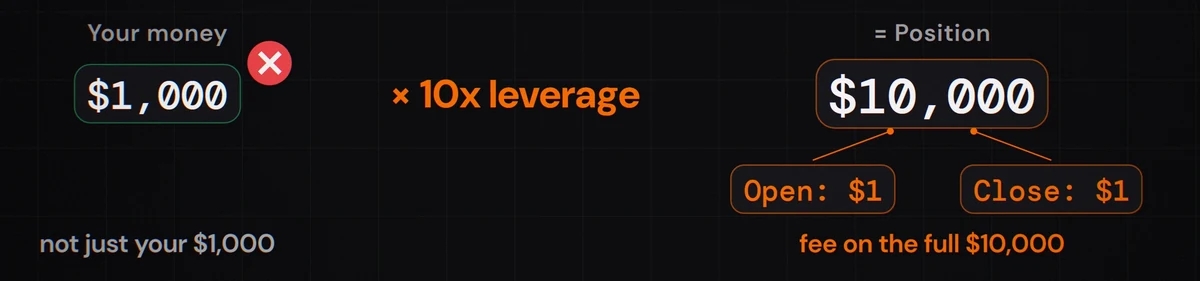
The fee is charged on the full $10,000, not just your $1,000: at 0.01%, that’s $1 to open and $1 to close.
Make both sides limit orders that wait on the book and the round trip is free. Over twenty round trips a month, that’s the difference between $40 and nothing.
Opening and closing are charged separately
You pay once when a position opens and again when it closes, each time on the price and size of that fill. In a worked trade in KCEX’s help center, opening 1 BTC as a taker at 50,000 USDT costs 5 USDT, and closing it at 55,000 USDT costs 5.5 USDT. The second fee is bigger only because the price rose.
KCEX charges nothing for orders that don’t fill, so a limit order you cancel costs no fee. To see what you’ve paid, open Fund Records and select Trading Fee.
Funding fees on perpetual futures
Funding is a payment between the traders on the two sides of a perpetual contract, separate from the trading fee. In KCEX’s words, long and short traders “periodically pay funding fees to one another” based on the funding rate, and “KCEX does not charge any fees from these payments.”
Longs and shorts pay each other at each funding time, usually every 8 hours, and KCEX takes no cut.
- Who pays: a positive rate means longs pay shorts, and a negative one means shorts pay longs.
- When: KCEX generally settles at 00:00, 08:00 and 16:00 UTC, every 8 hours. Some pairs follow a different schedule, which KCEX announces pair by pair.
- How much: the funding rate times your position’s value at the mark price. A rate of 0.01% on a $10,000 position moves $1. On BTCUSDT the rate can’t go beyond 2% either way.
- Only open positions count: if you hold nothing at settlement time, nothing is paid or received. Settlement can run about 15 seconds late, so a position opened at 16:00:05 can still be included.
Because KCEX’s trading fees are so low, funding can cost you more than trading does. At a positive rate of 0.01%, a $10,000 long pays $1 at every settlement, as much as the taker fee to open it. If the rate stays there for a day, three settlements cost $3, more than the $2 of trading fees for the whole round trip.
TradFi futures and tokenized stocks
KCEX also lists perpetual futures on traditional markets, under the RWA tab of its Markets page: stocks such as Nvidia, ETFs, gold, silver and oil. They trade in USDT like the crypto contracts, pay the same 0.00% maker and 0.01% taker, and have funding too. KCEX’s help center doesn’t cover their trading hours or what happens while a stock market is closed.
On spot, KCEX lists some tokenized stocks too, such as NVDAON/USDT, and like every spot pair they cost 0.00% to trade.
How to pay less on KCEX
KCEX has no VIP levels and no fee token, so nothing you do lowers the published rates. What you can change is how your orders fill and how big your positions are.
- Use limit orders on futures. A limit order that waits on the book pays 0.00% instead of 0.01%. Opening and closing the $10,000 position that way costs nothing, against $1 each way with market orders.
- Use Post Only to make sure you pay the maker fee. In the futures order form, Post Only (under Advanced Limit) cancels an order that would fill at once. KCEX suggests it for a trader who “wants the order to be executed as a Maker order to reduce trading fees”.
- Remember that leverage multiplies the fee. The same $1,000 at 20x is a $20,000 position, and a market order on it costs $2 per side instead of $1.
- Look at the funding rate before holding a position for days. On KCEX, a day of funding can cost more than opening and closing the position.
- Sign up through TradeGetPaid and get 50% of your trading fees back, as the next section shows.
KCEX fees after cashback
When you join KCEX through a referral link, KCEX pays a share of your trading fees to whoever referred you. TradeGetPaid passes 50% of your KCEX trading fees on to you. The order form still shows the regular rate, and the cashback is paid to you separately.
Spot trades, futures maker orders and zero-fee meme pairs cost nothing, so they have no fee to share. The cashback works on the futures taker fee, which drops from 0.01% to an effective 0.005%. Take the $10,000 position again: market orders cost $2 to open and close it, $1 comes back, and your real cost is $1.
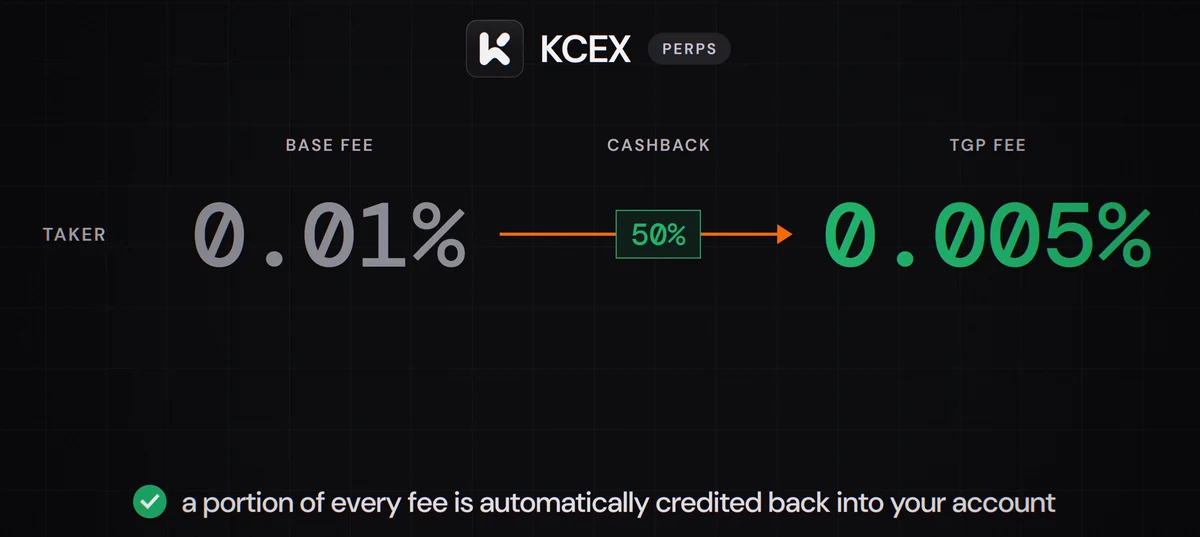
The regular KCEX futures taker fee of 0.01% becomes an effective 0.005% with 50% cashback. Maker orders already cost 0.00%.
Over a month of futures market orders at the regular 0.01% taker rate, the cashback adds up like this:
| Monthly futures volume | Taker fees | 50% back | What you really pay |
|---|---|---|---|
| $400,000 (20 round trips of $10,000) | $40 | $20 | $20 |
| $1,000,000 | $100 | $50 | $50 |
| $25,000,000 | $2,500 | $1,250 | $1,250 |
| $100,000,000 | $10,000 | $5,000 | $5,000 |
With no VIP levels, the published rate doesn’t fall as your volume grows, so the cashback grows in step with it.
Fees paid with KCEX’s futures trial funds are the exception: KCEX leaves them out of affiliate commission, so they earn no cashback.
Start trading on KCEX with lower fees
Sign up through TradeGetPaid and get 50% of your KCEX trading fees back automatically.
Fees change, so check your own rate on KCEX’s Trading Fees page, or under the order form for a single pair, before you trade. Official sources: trading fees, 0 Fee Calculator, futures fee calculation, funding rate, futures order types, zero-fee meme futures.
Frequently asked questions
Spot costs 0.00% for makers and 0.00% for takers. Futures cost 0.00% for makers and 0.01% for takers, and that includes stock, gold and oil contracts. These are the published rates for every account, since KCEX has no VIP levels.
Yes. Every spot pair currently costs 0.00% for makers and takers. KCEX hasn’t set an end date, and it says any change to its fees will be announced in advance.
Yes. You pay when the position opens and again when it closes, each time on that fill’s price and size. With market orders, a $10,000 position costs $1 each way.
Generally every 8 hours, at 00:00, 08:00 and 16:00 UTC, though some pairs follow their own schedule. It passes between longs and shorts, KCEX takes none of it, and only positions open at settlement pay or receive it.
No. KCEX publishes one set of rates for all accounts, with no levels and no volume or balance requirements. Its fee page has a “Check Exclusive Rates” button, but it leads to a login, and KCEX doesn’t publish those rates.
KCEX runs a zero-fee promotion for meme coin futures until 16:00 UTC on 24 March 2027, but it doesn’t publish a list of the pairs. Check the fee under the order form: on DOGE/USDT, for instance, it shows no fee for makers or takers.
No. They’re perpetual futures like the crypto contracts and pay the same 0.00% maker and 0.01% taker.