- Spot: 0.10% for makers and 0.10% for takers on a regular account, and no VIP level lowers it.
- Futures: 0.02% maker and 0.06% taker, worked out on the full leveraged position and paid on the way in and again on the way out.
- TradFi futures on stocks, metals and oil cost the same as crypto futures.
- Funding passes between traders and never to BYDFi: every 8 hours on BTC and ETH, every 4 hours on many other contracts. A position closed before the funding time neither pays nor receives it.
- VIP levels only touch futures fees. Any one of a level’s three conditions qualifies you, and for VIP 1 that can be 50,000 USDT in assets.
- TradeGetPaid gives you back 50% of your BYDFi spot and futures fees, so futures effectively cost 0.01% as a maker and 0.03% as a taker.
BYDFi fees at a glance
| Fee | Maker | Taker |
|---|---|---|
| Spot | 0.10% | 0.10% |
| Futures | 0.02% | 0.06% |
| TradFi futures (stocks, ETFs, metals, oil) | 0.02% | 0.06% |
Rates for a regular account (VIP 0). Higher VIP levels lower the crypto futures rates, while spot stays the same at every level. Futures and TradFi positions also pay or receive funding at set times. That money passes between traders, and BYDFi takes no share of it.
If you’d rather watch than read, we also have a video guide on BYDFi fees.
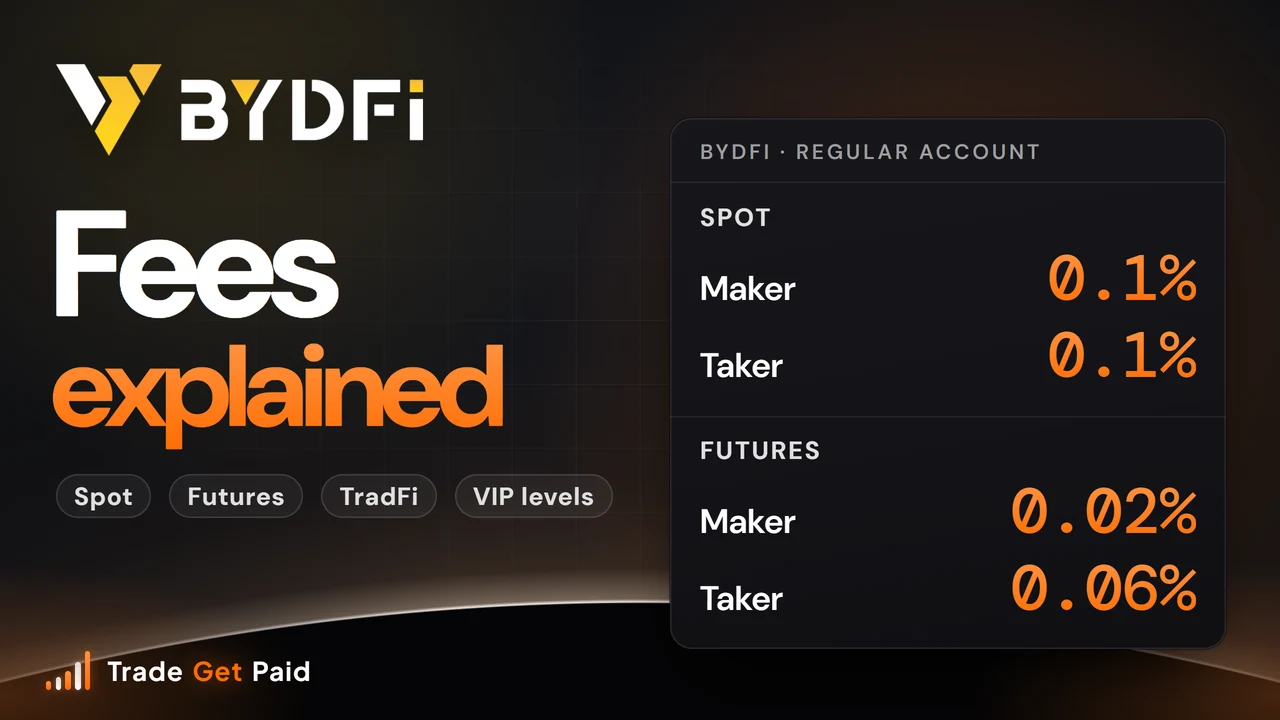 Play the video: BYDFi Fees Explained (Spot, Futures, VIP Levels) And How To Reduce your BYDFi Fees by 50%
BYDFi fees explained (5:20).
Pressing play loads the video from YouTube. Privacy policy
Maker or taker: which fee you pay
A market order fills immediately against orders already waiting in the order book. It takes liquidity out of the order book, so you pay the taker fee.
A limit order that can’t fill immediately sits in the order book at your price until another trader fills it. It adds liquidity, so you pay the maker fee.
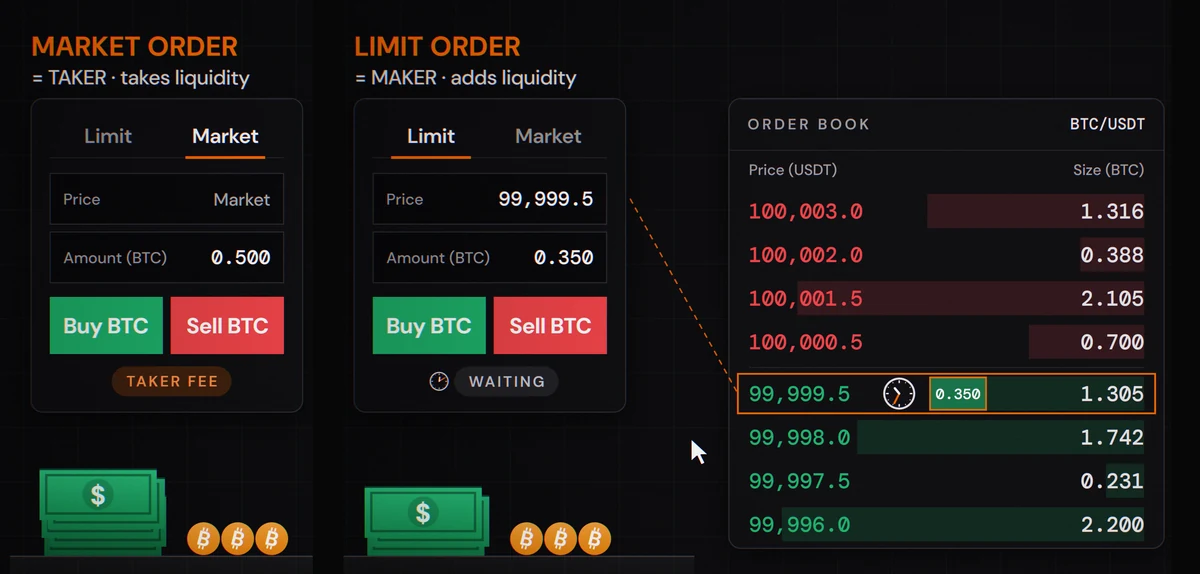
The market order trades at once and pays the taker fee. The limit order waits on the book and pays the maker fee once it fills.
A limit order that matches an order already in the book the moment you place it still pays the taker fee. On futures, BYDFi’s Post Only option prevents that: a post-only order that would fill at once is cancelled instead, so it either waits on the book as a maker or doesn’t trade. For more on the two order types, see our maker vs taker guide.
You only pay when an order fills. An order that never fills, or that you cancel, costs nothing.
BYDFi spot fees
A spot trade buys or sells the coin itself, so what you buy is yours to keep on BYDFi or withdraw. On a regular account the rate is 0.10% for makers and 0.10% for takers. With both rates the same, a limit order costs no less than a market order, and a higher VIP level doesn’t change the rate either.
On a $1,000 Bitcoin buy, the fee is $1. BYDFi takes it from what you receive: from the bitcoin when you buy, and from the USDT when you sell. Selling $1,000 of Bitcoin later costs another $1, so a $1,000 round trip comes to $2.
Binance and Bybit charge a regular account 0.1% on both sides as well, so BYDFi’s spot fee is at the usual level among the big exchanges. A new account elsewhere can pay a lot more: Kraken Pro starts new accounts at 0.4% for makers and 0.8% for takers, and Coinbase Exchange starts them at 0.4% and 0.6%.
The spot tab of BYDFi’s fee page shows a lower figure. It lists pairs such as BTC/USDT and ETH/USDT at 0.0800%, with 0.1000% struck through beside it, and nothing on the page, in BYDFi’s help center or in its announcements says what the 0.0800% is. The BTC/USDT order form shows 0.1000%, and BYDFi’s VIP page and help articles give the same rate, so that’s the one this guide uses. Your trade history shows the fee charged on every filled order.
BYDFi futures fees
BYDFi’s futures are perpetual contracts: instead of the coin, you hold a contract that tracks its price. You can bet on a rise (long) or a fall (short), and with leverage your position can be many times the size of your own stake. On BTCUSDT and ETHUSDT, BYDFi offers up to 500x for a limited time, starting 30 September 2026. The cap falls as a position grows: on BTCUSDT, 500x only covers positions up to 50,000 USDT, positions up to 100,000 USDT get 200x, and the largest get 1x.
On a regular account the rates are 0.02% for makers and 0.06% for takers, and on USDT contracts such as BTCUSDT, BYDFi takes the fee in USDT. Both rates are lower than spot’s, but with leverage a futures trade can cost far more in dollars.
Why leverage makes futures fees bigger
BYDFi works out the fee from the size of the trade and its price. Leverage isn’t part of that calculation. It only decides how much margin you put up. Put $1,000 of your own money into a trade at 10x and you hold a $10,000 position, and the fee is charged on the $10,000.
A market order to open that position costs $6, and closing it the same way costs another $6. The $12 in total is 1.2% of the $1,000 you put in, and you pay it whether the trade wins or loses. Buying and selling $1,000 of Bitcoin on spot costs $2.
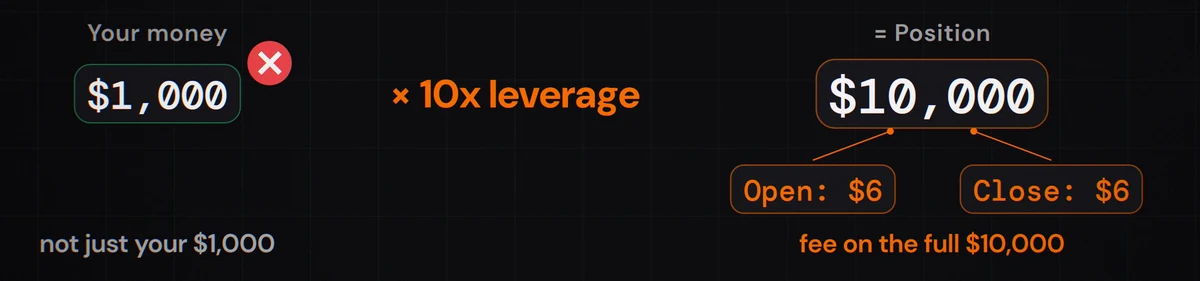
The fee is charged on the full $10,000, not on your $1,000: $6 to open and $6 to close at the regular taker rate.
With limit orders that wait on the book, each side costs $2 and the round trip $4. Trade like that 20 times a month and market orders cost you $240, limit orders $80.
Opening and closing are charged separately
BYDFi charges each side of a futures trade on its own, at that side’s price and at the rate of that order. Its help center works through a short of 0.4 BTC, opened with a market order at 40,000 USDT and closed at 39,000 USDT. Opening costs 9.60 USDT and closing 9.36 USDT, 18.96 USDT in all. The closing fee is smaller because the position was worth less by the time it closed.
Funding fees on perpetual futures
Perpetual futures also carry funding: payments between traders holding long and short positions, made at set times. Funding is separate from the trading fee, and BYDFi keeps none of it.
Funding passes between longs and shorts, not to BYDFi. On BTCUSDT it’s settled every 8 hours, at 00:00, 08:00 and 16:00 UTC.
- Who pays whom: a positive funding rate means longs pay shorts, and a negative one means shorts pay longs.
- When: every 8 hours on BTCUSDT and ETHUSDT, at 00:00, 08:00 and 16:00 UTC. Many other contracts, gold, oil and HYPE among them, settle every 4 hours, six times a day instead of three. Each contract’s page shows its cycle, and BYDFi announces it when one changes.
- How much: the position’s value at the mark price when funding is settled, times the funding rate. BYDFi’s help center treats 0.01% either way as a typical rate, and at 0.01% a $10,000 position pays or receives $1 each time.
- Only open positions: a position you close before the funding time doesn’t pay or receive anything for that settlement.
- Where it comes from: your available margin first, then the position’s own margin if that isn’t enough.
TradFi futures
BYDFi’s TradFi markets are perpetual futures on traditional assets: stocks, ETFs, gold, silver, copper and crude oil. They’re part of BYDFi’s futures market, margined in USDT, and a regular account pays the same 0.02% maker and 0.06% taker as on crypto futures.
A stock contract follows the share price, but it doesn’t make you a shareholder: you get no dividends and no voting rights. Funding works as it does on crypto contracts, and gold and oil settle it every 4 hours. Leverage is lower than on BTC and differs from one contract to the next.
BYDFi VIP levels
BYDFi’s VIP scale runs from VIP 0 to VIP 7, and moving up it only changes futures fees: spot stays at 0.10% maker and 0.10% taker at every level. To reach a level you need to meet just one of its three conditions, and the highest level any of them gives you is the one that counts. Logged in, the VIP page shows your own level and rates.
| Level | Futures maker | Futures taker |
|---|---|---|
| VIP 0 | 0.020% | 0.060% |
| VIP 1 | 0.018% | 0.060% |
| VIP 2 | 0.016% | 0.050% |
| VIP 3 | 0.014% | 0.040% |
| VIP 4 | 0.012% | 0.040% |
| VIP 5 | 0.010% | 0.035% |
| VIP 6 | 0.008% | 0.032% |
| VIP 7 | 0.007% | 0.030% |
Rates from BYDFi’s VIP page, checked 15 October 2026.
VIP 1 lowers only the maker fee, from 0.02% to 0.018%. The taker fee, which every market order pays, first drops at VIP 2, to 0.05%, and VIP 3 and VIP 4 share the same 0.04%. No level is free of charge: at VIP 7, makers still pay 0.007%. BYDFi’s VIP FAQ says higher levels lower spot fees as well, but the page’s own fee table shows the same spot rate at every level.
For big traders the levels add up. Someone trading $25 million of futures a month reaches VIP 2, where that volume costs $12,500 in taker fees instead of $15,000 at the regular rate. At $100 million a month, VIP 5’s 0.035% brings it to $35,000 instead of $60,000.
How to reach each level
| Level | 30-day futures volume | 30-day spot volume | Assets |
|---|---|---|---|
| VIP 1 | 10,000,000 USDT | 100,000 USDT | 50,000 USDT |
| VIP 2 | 20,000,000 USDT | 500,000 USDT | 100,000 USDT |
| VIP 3 | 30,000,000 USDT | 1,000,000 USDT | 250,000 USDT |
| VIP 4 | 50,000,000 USDT | 2,000,000 USDT | 750,000 USDT |
| VIP 5 | 100,000,000 USDT | 5,000,000 USDT | 2,000,000 USDT |
| VIP 6 | 200,000,000 USDT | 10,000,000 USDT | 5,000,000 USDT |
| VIP 7 | 5,000,000,000 USDT | 100,000,000 USDT | 50,000,000 USDT |
Assets are what you hold in your spot and futures accounts, including money tied up in open orders and position margin, but not unrealized profit or loss on futures. Sub-accounts count toward the main account. A few more rules:
- Spot trading can lower your futures fees. One level covers both, so 500,000 USDT of spot volume in 30 days is enough for VIP 2 and its lower futures taker fee.
- Levels update every day at 02:00 UTC. If an update fails, you keep your previous level.
- Assets are measured at random moments through the day, not at one fixed time.
- Only volume and assets count. No BYDFi token lowers your fees.
How to pay less on BYDFi
- Let futures orders wait on the book. Makers pay a third of what takers pay: $2 a side on the $10,000 position instead of $6. Post Only makes sure an order never fills as a taker by accident. On spot this saves nothing, since makers and takers pay the same.
- Keep leverage in proportion. The fee follows the size of the position, so $1,000 at 20x opens a $20,000 position and costs $12 with a market order, twice the 10x figure.
- Check funding before you hold a position for days. Look at the contract’s rate and its cycle: on a 4-hour cycle, funding is settled six times a day, twice as often as on BTCUSDT.
- Don’t count on VIP 1 for market orders. It only lowers the futures maker fee. A lower taker fee starts at VIP 2: 20,000,000 USDT of 30-day futures volume, 500,000 USDT of spot volume or 100,000 USDT in assets.
- Sign up through a cashback site, and part of your fees comes back, as the next section shows.
BYDFi fees after cashback
When you open an account through an affiliate link, BYDFi pays that affiliate a commission out of the trading fees you pay. TradeGetPaid shares it with you: on BYDFi, you get back 50% of your spot and futures trading fees, at every VIP level. The rates BYDFi charges stay exactly as they are.
That brings the regular futures rates down to an effective 0.01% maker and 0.03% taker, and spot from 0.10% to 0.05%. The $10,000 futures round trip from earlier costs $12 with market orders, and $6 of it comes back, so you really pay $6. A $1,000 spot buy costs $1, of which $0.50 comes back.
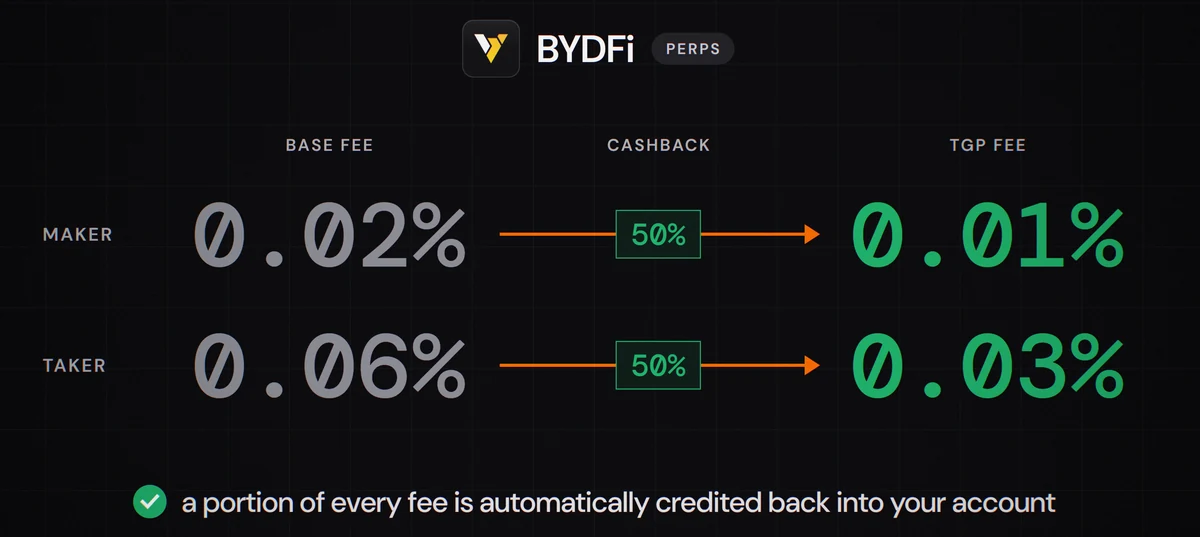
BYDFi’s regular futures rates, and what’s left of them after 50% cashback.
Over a month of futures trading with market orders, your 30-day futures volume sets your VIP level, so each row uses the taker rate that volume reaches:
| Monthly futures volume | Level and taker fee | Fees | 50% back | What you really pay |
|---|---|---|---|---|
| $50,000 | VIP 0, 0.06% | $30 | $15 | $15 |
| $250,000 | VIP 0, 0.06% | $150 | $75 | $75 |
| $1,000,000 | VIP 0, 0.06% | $600 | $300 | $300 |
| $25,000,000 | VIP 2, 0.05% | $12,500 | $6,250 | $6,250 |
| $100,000,000 | VIP 5, 0.035% | $35,000 | $17,500 | $17,500 |
At $25 million and $100 million a month, your volume reaches VIP 2 and VIP 5, so BYDFi’s lower rate applies first and the 50% comes back on that.
BYDFi doesn’t pay its affiliates commission on every fee. Its rules leave out fees on trades held for less than a minute, and fees covered by a futures bonus or a fee voucher.
Start trading on BYDFi with lower fees
Sign up through TradeGetPaid and 50% of your BYDFi spot and futures trading fees come back to you.
Fees change, so check your own rate on BYDFi’s fee page before you trade. Official sources: fee page, VIP levels, fee calculation, funding fees, futures order types, 500x leverage notice.
Frequently asked questions
On a regular account, spot costs 0.10% for makers and 0.10% for takers, and futures cost 0.02% and 0.06%. Higher VIP levels lower only the futures fees.
BYDFi doesn’t say. Its fee page lists spot pairs such as BTC/USDT at 0.0800% beside a struck-through 0.1000%, while the BTC/USDT order form shows 0.1000% and the VIP page and BYDFi’s help articles give the same rate. Your trade history shows the fee you were actually charged.
No. Spot is 0.10% for makers and 0.10% for takers from VIP 0 to VIP 7. Only futures fees fall, starting with the maker fee at VIP 1.
Yes. Each side is charged on its own, on that side’s size and price and at that order’s maker or taker rate. With market orders, a $10,000 position costs $6 to open and $6 to close.
Every 8 hours on BTCUSDT and ETHUSDT, at 00:00, 08:00 and 16:00 UTC. Many other contracts, including gold and oil, settle every 4 hours, and each contract’s page shows its cycle. Funding only touches positions that are open at settlement, and none of it goes to BYDFi.
Meet one of these: 50,000 USDT in assets, 10,000,000 USDT of 30-day futures volume, or 100,000 USDT of 30-day spot volume. VIP 1 lowers the futures maker fee to 0.018%, and the taker fee stays the same until VIP 2.
No. Futures on stocks, ETFs, metals and oil cost a regular account the same 0.02% maker and 0.06% taker as crypto futures.