- Spot: a regular account pays 0.20% as a maker and 0.30% as a taker, and no VIP level lowers either rate.
- Futures: 0.03% maker and 0.055% taker, charged on the full position when you open it and again when you close it.
- TradFi trades on gold, oil, indices, forex and stocks carry no trading fee for now. You pay the spread instead.
- Funding is paid between traders, not to BTCC, usually every 8 hours, and you only pay or receive it if your position is open at that moment.
- VIP levels lower the futures rates. One condition per level is enough, and BTCC’s fee page puts VIP 1 at 200 USDT in assets.
- With TradeGetPaid you get 50% of your spot and futures fees back, which takes the futures rates to 0.015% maker and 0.0275% taker.
BTCC fees at a glance
| Fee | Maker | Taker |
|---|---|---|
| Spot | 0.20% | 0.30% |
| Futures (USDT-margined perpetuals) | 0.03% | 0.055% |
| TradFi (gold, oil, indices, forex, stocks) | No fee | No fee |
Rates for a regular account (VIP 0). Higher VIP levels pay less on futures, while spot costs the same at every level. Futures positions also pay or receive funding at set times. It changes hands between traders, and BTCC keeps none of it. TradFi’s zero fee is an offer that began on 1 June 2026 with no end date announced, and you still pay the spread.
If you’d rather watch than read, we also have a video guide on BTCC fees.
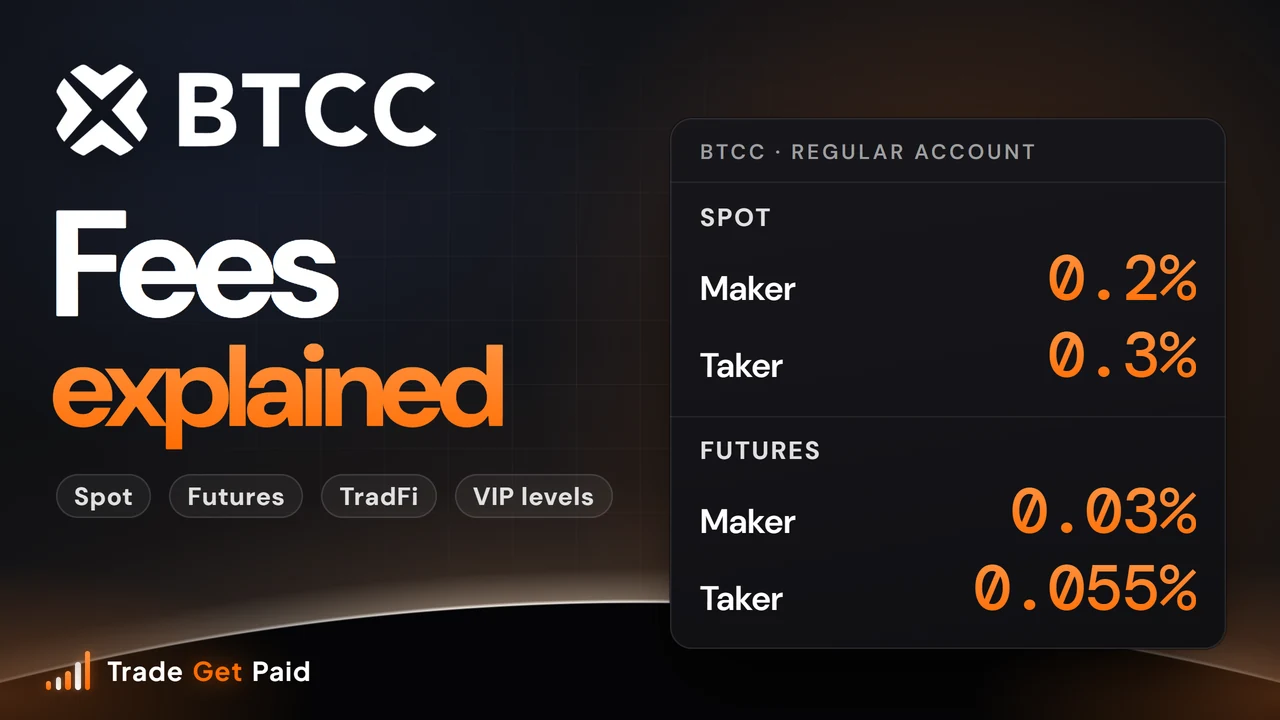 Play the video: BTCC Fees Explained (Spot, Futures, VIP Levels) And How To Reduce your BTCC Fees by 50%
BTCC fees explained (5:25).
Pressing play loads the video from YouTube. Privacy policy
Maker or taker: which fee you pay
A market order fills immediately against orders already waiting in the order book. It takes liquidity out of the order book, so you pay the taker fee.
A limit order goes into the order book at your price and waits for someone to trade against it. Once an order has entered the order book, BTCC counts every trade that later fills it as a maker trade, at the lower maker fee.
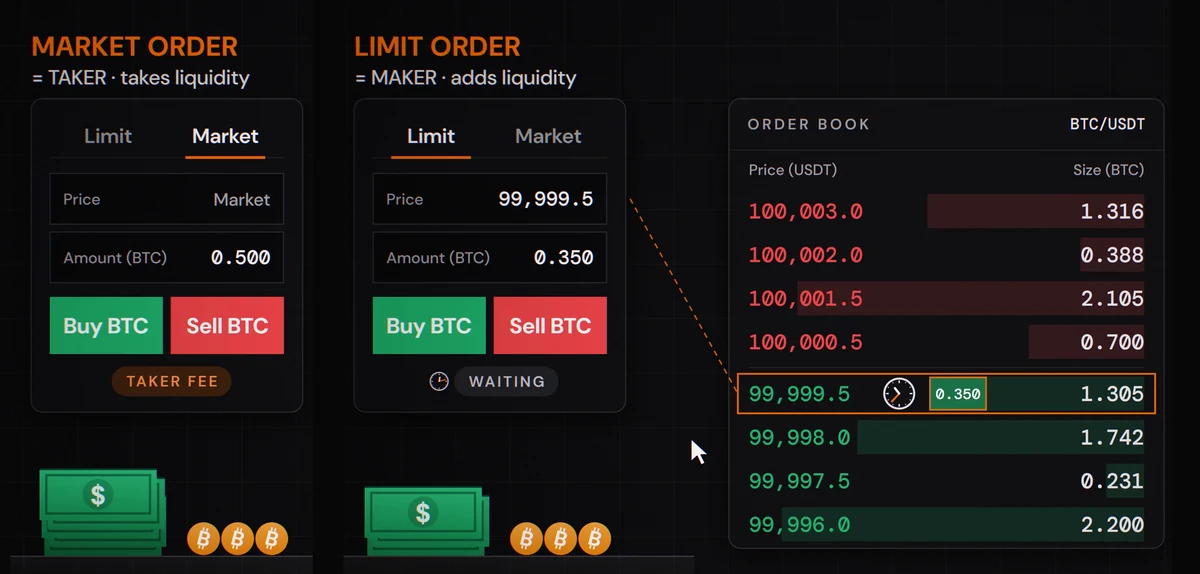
A market order takes liquidity and pays the taker fee. A limit order that waits on the book adds liquidity and pays the maker fee.
A limit order only gets the maker rate if it waits. If it’s priced to match an order already in the book, it fills straight away and pays the taker fee. BTCC’s help center points out that “you can also use limit orders to act as a taker”. For more on how the two fees work, see our maker vs taker guide.
BTCC spot fees
Spot means buying the coin itself, which you can keep on BTCC or withdraw. A regular account pays 0.20% as a maker and 0.30% as a taker. BTCC’s fee page lists the same two rates at every level from VIP 0 to VIP 7, so a higher level doesn’t make spot any cheaper.
Buy $1,000 of Bitcoin with a market order and the fee is $3. Place it as a limit order that waits in the book and it’s $2. Selling costs the same again, so a $1,000 round trip comes to $6 with market orders, or $4 with limit orders.
That’s more than Binance and Bybit charge: both take 0.1% from a regular account, as maker and as taker. Kraken Pro and Coinbase Exchange cost more than BTCC. A new account pays 0.4% maker and 0.8% taker on Kraken Pro, and 0.4% and 0.6% on Coinbase Exchange.
BTCC futures fees
BTCC’s futures are perpetual contracts. You hold a contract that tracks a coin’s price rather than the coin, so there’s nothing to withdraw, and you can go long if you expect the price to rise or short if you expect it to fall. Leverage lets you open a bigger position than the money you put in. In February 2026 BTCC lowered the maximum on its BTC, ETH, XRP, DOGE and SOL contracts from 500x to 250x, and the limit varies from contract to contract.
The rates here are for USDT-margined perpetuals, where you put up USDT as margin. A regular account pays 0.03% as a maker and 0.055% as a taker. BTCC cut its futures fees in April and June 2026, then on 24 September raised the regular taker fee from 0.048% to 0.055% and kept the maker fee at 0.03%.
These rates are a fraction of the spot rates, yet a futures trade can cost more in dollars than a spot trade with the same money. Leverage is the reason.
Why leverage makes futures fees bigger
BTCC works out the fee on the full value of your position, not on the margin behind it: the fee rate times the position’s size times the price it fills at. Put in $1,000 with 10x leverage and you hold a $10,000 position, so the fee is charged on $10,000.
With market orders, opening that position costs $5.50 and closing it another $5.50. That’s $11 in fees, or 1.1% of your own $1,000, even if the price never moves. A $1,000 spot round trip with market orders costs $6.
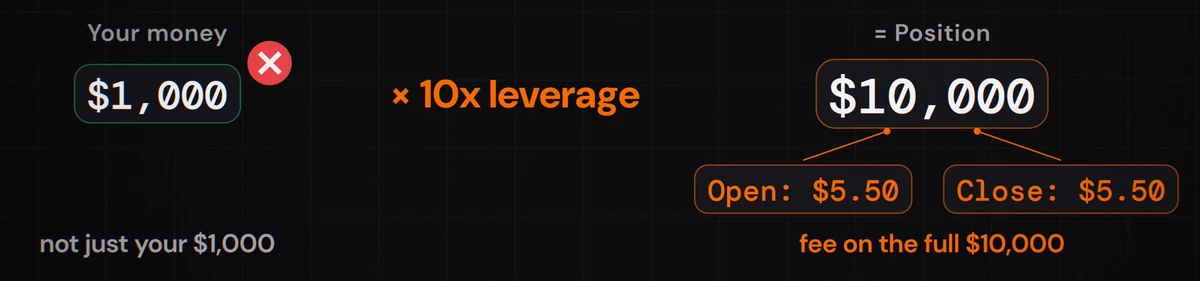
With 10x leverage, $1,000 of margin opens a $10,000 position. At the regular taker rate, opening it costs $5.50 and closing it another $5.50.
With limit orders on both sides, the futures round trip costs $6: $3 to open and $3 to close. Over 20 round trips a month, that’s $120 in fees instead of $220.
Opening and closing are charged separately
BTCC charges one fee when you open a position and another when you close it. Each side pays the maker or taker rate of your VIP level at that moment, on the price that order fills at. If your $10,000 position has grown to $11,000 by the time you close it with a market order, the closing fee is $6.05 rather than $5.50.
Funding fees on perpetual futures
A perpetual contract has no expiry date, so funding payments are what keep its price close to the coin’s spot price. On BTCC they pass between traders holding long and short positions, and BTCC keeps none of them: its help center says “BTCC does not take any funding fees”. Funding comes on top of the trading fee.
Funding goes between longs and shorts, not to BTCC, usually every 8 hours.
- Who pays: a positive funding rate means longs pay shorts, and a negative one means shorts pay longs.
- When: usually every 8 hours, at 00:00, 08:00 and 16:00 UTC. BTCC moves some pairs to other schedules (LSK/USDT went from every hour to every 4 hours in September 2026), so check the contract before you hold it for long.
- How much: your position value times the funding rate. At 0.01%, a $10,000 position pays or receives $1 per settlement. In BTCC’s own example, 1 BTC at 95,000 USDT and a rate of 0.02% comes to 19 USDT. The rate moves with the market, and the trading page shows the current one.
- Only at settlement: you pay or receive funding only if your position is open at a funding time. BTCC warns that a position opened or closed a few seconds after the hour, at 08:00:05 for example, can still be charged or paid.
BTCC TradFi fees
TradFi is BTCC’s market for gold, oil, indices, forex and stocks. You trade their price with USDT as margin, without owning the asset. TradFi has its own account, which you move USDT into, and order sizes are in lots.
Since 1 June 2026, opening and closing a TradFi position has cost no trading fee. BTCC hasn’t given an end date and says it will announce any return of fees separately. What you pay instead is the spread, the gap between the price you can buy at and the price you can sell at.
The contract details on BTCC’s TradFi trading page also have a row for rollover fees, the cost of holding a position overnight. BTCC hasn’t published those rates or said whether the zero-fee offer covers them, so check that row before you hold a TradFi position for days.
BTCC VIP levels
BTCC has eight levels, VIP 0 to VIP 7. They only lower the futures rates. Spot stays at 0.20% maker and 0.30% taker at every level. To reach a level, you need to meet just one of its three conditions.
| Level | Futures maker | Futures taker |
|---|---|---|
| VIP 0 | 0.03% | 0.055% |
| VIP 1 | 0.025% | 0.05% |
| VIP 2 | 0.022% | 0.045% |
| VIP 3 | 0.02% | 0.04% |
| VIP 4 | 0.018% | 0.032% |
| VIP 5 | 0.015% | 0.025% |
| VIP 6 | 0.012% | 0.02% |
| VIP 7 | 0.01% | 0.015% |
Rates from BTCC’s fee page, checked 15 October 2026.
How to reach each level
| Level | 30-day futures volume | 30-day spot volume | Assets |
|---|---|---|---|
| VIP 1 | 500,000 USDT | 100,000 USDT | 200 USDT |
| VIP 2 | 7,500,000 USDT | 700,000 USDT | 15,000 USDT |
| VIP 3 | 20,000,000 USDT | 3,000,000 USDT | 100,000 USDT |
| VIP 4 | 75,000,000 USDT | 3,000,000 USDT | 200,000 USDT |
| VIP 5 | 200,000,000 USDT | 25,000,000 USDT | 1,000,000 USDT |
| VIP 6 | 500,000,000 USDT | 40,000,000 USDT | 2,000,000 USDT |
| VIP 7 | 1,000,000,000 USDT | 60,000,000 USDT | 3,000,000 USDT |
Conditions from BTCC’s fee page, checked 15 October 2026. It lists the same spot volume for VIP 3 and VIP 4.
For VIP 1, the fee page says that once you’ve deposited 200 USDT in total, you move up from VIP 0 immediately. BTCC’s announcement of the 24 September changes gave 500 USDT in assets for VIP 1 instead. Either way, an account holding the $1,000 from this guide’s examples qualifies. A few more rules:
- Assets means your futures account balance plus your wallet balance, spot included, plus any unrealized profit or loss.
- Levels and rates update every day at 17:00 UTC.
- Coming from another exchange? The fee page has an “Apply for VIP+1 Status” option for traders who hold VIP status elsewhere, which BTCC reviews manually.
How to pay less on BTCC
- Use limit orders. On futures, a maker pays 0.03% instead of 0.055%, so each side of the $10,000 example costs $3 instead of $5.50. On spot it’s 0.20% instead of 0.30%: $2 instead of $3 on a $1,000 buy.
- Check that you’re at VIP 1. An account holding the $1,000 from our example already qualifies, and VIP 1 pays 0.025% maker and 0.05% taker on futures: $5 a side on the $10,000 position instead of $5.50. Spot fees stay the same.
- Keep leverage in check. At 20x, the same $1,000 opens a $20,000 position, and each side costs $11 at the regular taker rate.
- Check funding before you hold a position for days. At a rate of 0.01%, a $10,000 position pays or receives $3 a day over the usual three settlements.
- Get half your fees back with cashback, as the next section shows.
BTCC fees after cashback
BTCC pays its partners a commission based on the trading fees of the users they refer, and TradeGetPaid passes part of it back to you. On BTCC, you get 50% of your spot and futures trading fees back. You pay BTCC its normal fee on each trade, and half of it comes back to you afterwards.
On futures, that brings the regular rates down to an effective 0.015% maker and 0.0275% taker. On spot, 0.20% becomes 0.10% and 0.30% becomes 0.15%. The $10,000 futures round trip from earlier costs $11 with market orders, and $5.50 of it comes back, so you really pay $5.50.
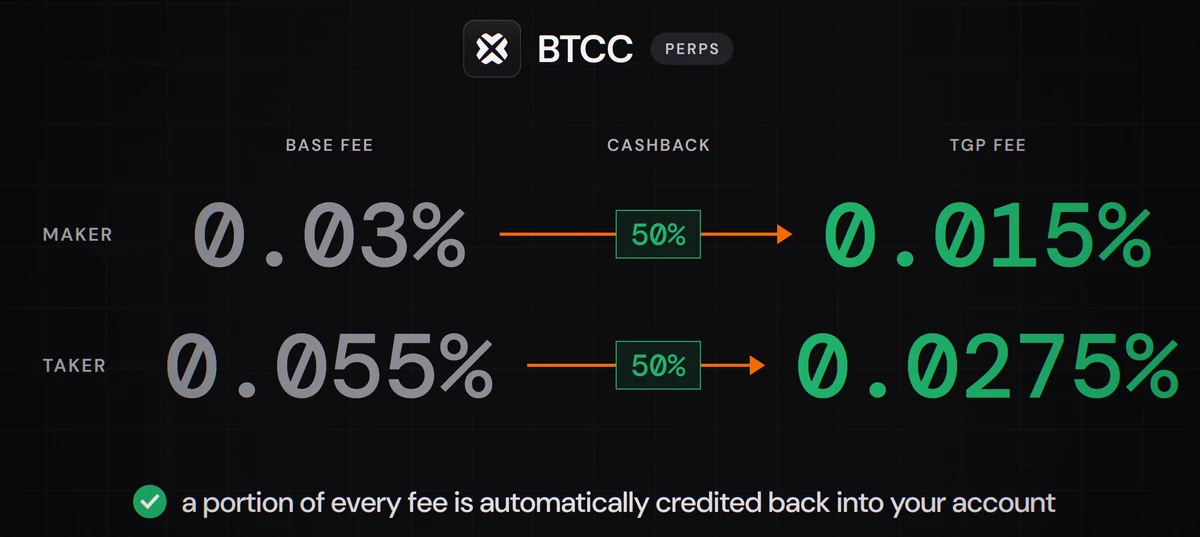
BTCC’s regular futures rates before and after 50% cashback.
Here’s a month of futures trading with market orders, at the VIP level each volume reaches:
| Monthly futures volume | Level and taker fee | Fees | 50% back | What you really pay |
|---|---|---|---|---|
| $400,000 (20 round trips of $10,000) | VIP 0, 0.055% | $220 | $110 | $110 |
| $1,000,000 | VIP 1, 0.05% | $500 | $250 | $250 |
| $25,000,000 | VIP 3, 0.04% | $10,000 | $5,000 | $5,000 |
| $100,000,000 | VIP 4, 0.032% | $32,000 | $16,000 | $16,000 |
The levels in the table come from futures volume alone. An account holding the $1,000 from our example is at VIP 1 anyway, and then the $400,000 month costs $200 in fees, or $100 after cashback. TradFi trades carry no fee for now, so there’s nothing to pay back on them.
Start trading on BTCC with lower fees
Sign up through TradeGetPaid and 50% of your BTCC spot and futures trading fees come back to you.
Fees change, so check the current rates on BTCC’s fee page, listed as VIP Program in its menu, before you trade. Official sources: fee page, futures fee change of 24 September 2026, maker and taker, funding fees, zero-fee TradFi.
Frequently asked questions
A regular account pays 0.20% maker and 0.30% taker on spot, and 0.03% maker and 0.055% taker on USDT-margined futures. TradFi trades carry no trading fee for now.
No. Every level from VIP 0 to VIP 7 pays 0.20% as a maker and 0.30% as a taker on spot. VIP levels only lower futures fees.
Yes. Each side is charged on its own, on the full position value at the price that order fills, at the maker or taker rate of your VIP level.
Usually every 8 hours, at 00:00, 08:00 and 16:00 UTC, though some pairs settle on other schedules. You only pay or receive funding if your position is open at a funding time, and it goes between traders, not to BTCC.
BTCC’s fee page asks for any one of these: 200 USDT in assets, 500,000 USDT of 30-day futures volume, or 100,000 USDT of 30-day spot volume. It also says a deposit of 200 USDT moves you up from VIP 0 immediately.
Not at the moment. Since 1 June 2026, opening and closing TradFi positions on gold, oil, indices, forex and stocks has carried no trading fee, and BTCC hasn’t announced an end date. You still pay the spread.