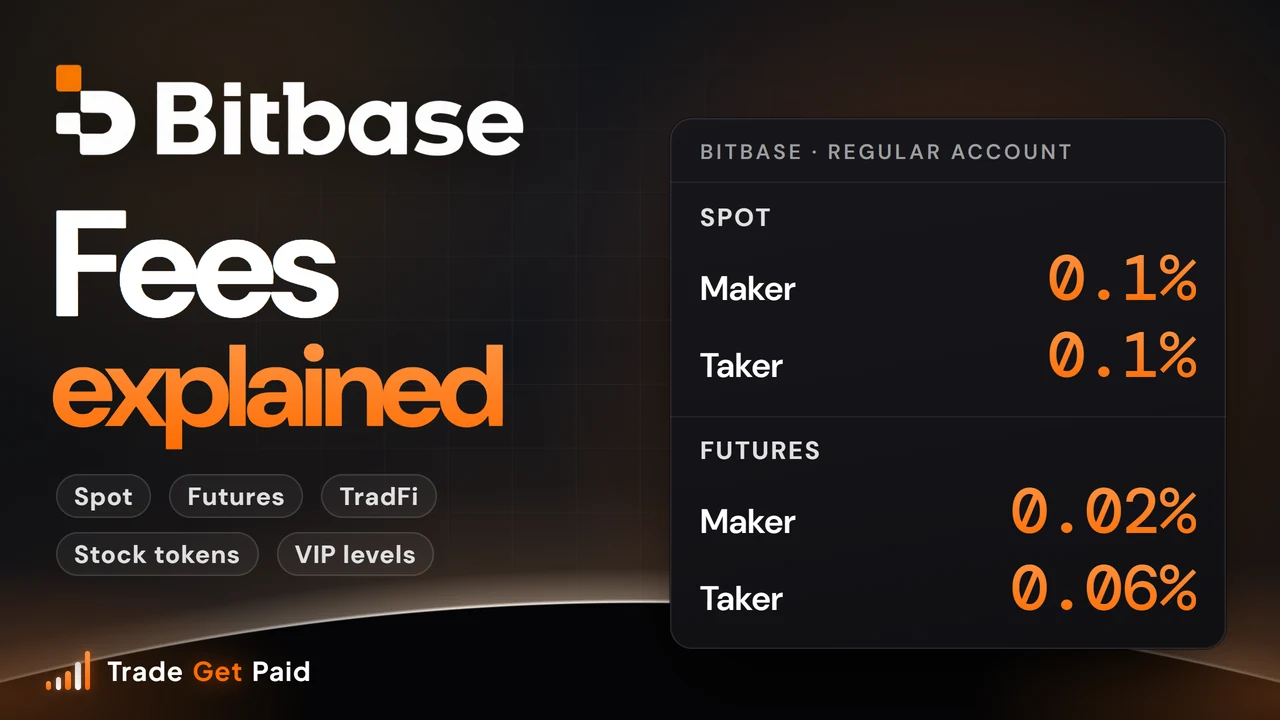
- Spot: a regular account pays 0.10% as a maker and 0.10% as a taker. The maker discount only starts at VIP 1.
- Futures: 0.02% maker and 0.06% taker, charged on the whole position, when you open and again when you close.
- TradFi perps and stock tokens pay the same rates as crypto futures and spot.
- Funding changes hands between traders every 8 hours on BTCUSDT, and only if your position is open at that moment.
- VIP levels lower both rates. One condition per level is enough, and VIP 1 starts at 30,000 USDT in your account.
- With TradeGetPaid you get 70% of your spot and futures fees back, which takes the futures rates to 0.006% maker and 0.018% taker.
Bitbase fees at a glance
| Fee | Maker | Taker |
|---|---|---|
| Spot | 0.10% | 0.10% |
| Futures | 0.02% | 0.06% |
| TradFi perps (stocks, forex, commodities, indices) | 0.02% | 0.06% |
| Stock and gold tokens (on spot) | 0.10% | 0.10% |
Rates for a regular account (VIP 0). Higher VIP levels pay less. On top of the trading fee, futures and TradFi positions pay or receive funding at set times, exchanged between the traders holding long and short positions.
If you’d rather watch than read, we also have a video guide on Bitbase fees.
 Play the video: Bitbase Fees Explained (Spot, Futures, VIP Levels) And How To Reduce your Bitbase Fees by 70%
Bitbase fees explained (5:21).
Pressing play loads the video from YouTube. Privacy policy
Maker or taker: which fee you pay
A market order fills immediately against orders already waiting in the order book. It takes liquidity out of the order book, so you pay the taker fee.
A limit order waits in the order book until someone trades against it. Bitbase’s fee page gives an example: with the best ask at 1,000 USDT, a buy order at 900 USDT is added to the order book, and once it fills, the maker fee applies.
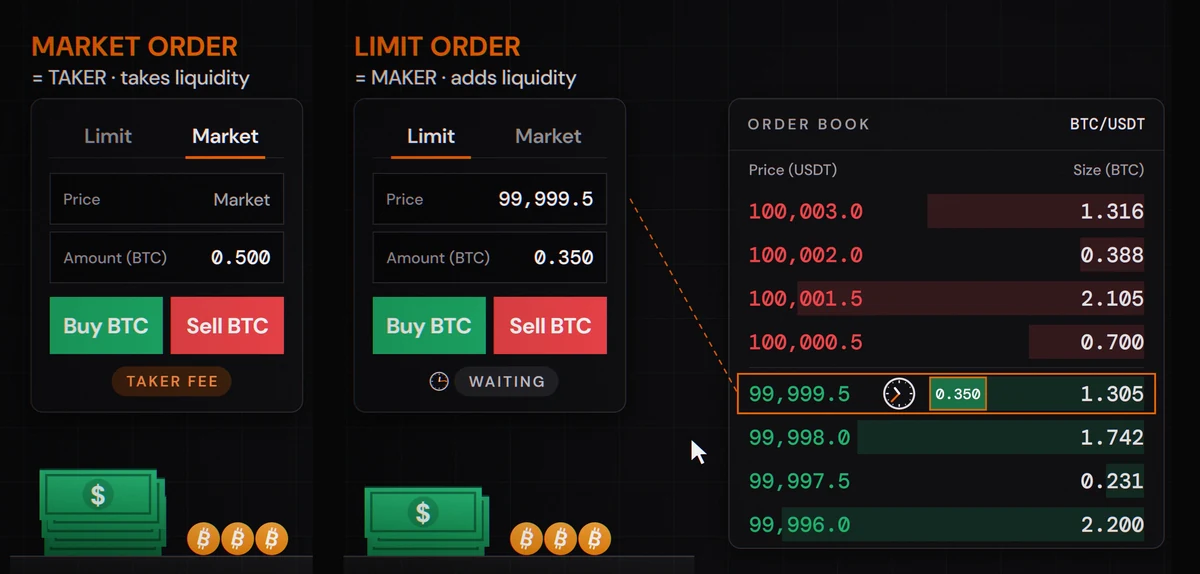
Market orders fill right away and pay the taker fee. Limit orders that wait on the book pay the maker fee.
A limit order that fills the moment you place it still counts as a taker order. Bitbase’s help center describes this as a price that “overlaps with an existing market price, resulting in an immediate execution”. Our maker vs taker guide explains the difference in more detail.
Bitbase spot fees
On spot you buy the coin itself, and you can hold it or withdraw it. A regular account pays 0.10% as a maker and 0.10% as a taker, so a limit order saves you nothing here. The maker discount begins at VIP 1, at 0.08% maker and 0.09% taker.
Buy $1,000 of Bitcoin and the fee is $1.00, whichever order type you use. Selling it later costs another $1, so a round trip on $1,000 comes to $2.
That’s the usual rate among the big exchanges: Binance and Bybit also charge a regular account 0.1% on both sides. Some cost a lot more. Kraken Pro charges a new account 0.4% as a maker and 0.8% as a taker, and Coinbase Exchange charges 0.4% and 0.6%.
Bitbase also lists tokenized stocks and gold on spot, at the same rate. One pair has no fee at all, USDC/USDT, but its volume doesn’t count toward VIP levels.
Bitbase futures fees
Bitbase’s futures are perpetual contracts, settled in USDT or USDC. You hold a contract that follows a coin’s price, so you can go long or short, and you can use leverage: up to 150x on BTCUSDT, and less as the position grows.
A regular account pays 0.02% as a maker and 0.06% as a taker, on USDT and USDC contracts alike. The rates look lower than on spot, but what you actually pay often isn’t, because of leverage.
Why leverage makes futures fees bigger
Bitbase charges futures fees on the value of your position, not on the margin you put up. Its own margin example uses the same numbers: a position worth 10,000 USDT at 10x leverage needs 1,000 USDT of margin. The fee is worked out on the 10,000.
With market orders, opening that position costs $6 and closing it costs another $6. That’s $12, or 1.2% of your own $1,000, before the price has moved at all. A $1,000 spot round trip costs $2.
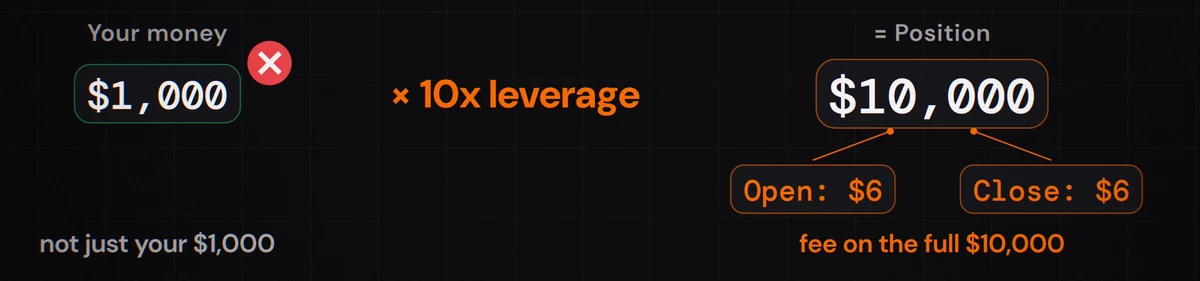
At 10x leverage, $1,000 of margin opens a $10,000 position, and each side costs $6 at the regular taker rate.
With limit orders on both sides, the same round trip costs $4. Twenty round trips a month come to $240 with market orders and $80 with limit orders.
Opening and closing are charged separately
Bitbase’s futures agreement says trading fees apply “at both the entry into and the close-out of a Transaction”, and since 16 July 2026 a position shows its opening and closing fees as separate lines. Each side is charged on the price and size of that trade, so if the price has risen by the time you close, the closing fee is a little higher.
Funding fees on perpetual futures
Perpetual contracts never expire, so exchanges use funding payments to keep their price close to the spot price. Bitbase describes these payments as “exchanged between traders holding long and short positions”. They’re separate from the trading fee.
Funding changes hands between longs and shorts, every 8 hours on BTCUSDT.
- Who pays: when the funding rate is positive, longs pay shorts. When it’s negative, shorts pay longs.
- When: every 8 hours on BTCUSDT, three times a day. Other contracts can differ: gold (XAUUSDT) settles every 4 hours. The trading page shows each contract’s settlement time.
- How much: your position value times the funding rate. At 0.01%, a $10,000 position pays or receives $1 per settlement. The rate moves with the market, within a cap of 2% either way on BTCUSDT.
- Only at settlement: close before the funding time and you neither pay nor receive anything. Bitbase notes that the actual time can be up to 60 seconds off.
TradFi and stock tokens
Bitbase also lists perpetual futures on stocks, forex, commodities and indices. They trade like crypto futures, in USDT, at the same 0.02% maker and 0.06% taker for a regular account. Funding can still apply while the underlying market is closed, so check it before you hold a position over a weekend.
If you’d rather hold a token than a contract, Bitbase lists tokenized stocks and gold on spot, at the regular spot rate.
Bitbase VIP levels
Bitbase has eight levels, VIP 0 to VIP 7, and one level covers spot and futures together. You reach a level by meeting any one of its conditions.
| Level | Spot maker | Spot taker | Futures maker | Futures taker |
|---|---|---|---|---|
| VIP 0 | 0.1000% | 0.1000% | 0.0200% | 0.0600% |
| VIP 1 | 0.0800% | 0.0900% | 0.0180% | 0.0550% |
| VIP 2 | 0.0700% | 0.0800% | 0.0160% | 0.0500% |
| VIP 3 | 0.0500% | 0.0600% | 0.0140% | 0.0450% |
| VIP 4 | 0.0400% | 0.0500% | 0.0120% | 0.0400% |
| VIP 5 | 0.0300% | 0.0400% | 0.0100% | 0.0350% |
| VIP 6 | 0.0200% | 0.0300% | 0.0080% | 0.0300% |
| VIP 7 | 0.0100% | 0.0200% | 0.0050% | 0.0250% |
Rates from Bitbase’s fee page, checked 15 October 2026.
The lowest futures maker fee is 0.005%, at VIP 7. There’s no zero or negative maker rate. On 4 September 2026 Bitbase raised the futures taker fee at six of its eight levels, and left the maker fees and the VIP 0 rates as they were.
How to reach each level
| Level | 30-day futures volume | 30-day spot volume | Balance |
|---|---|---|---|
| VIP 1 | 5,000,000 USDT | 500,000 USDT | 30,000 USDT |
| VIP 2 | 10,000,000 USDT | 2,000,000 USDT | 50,000 USDT |
| VIP 3 | 20,000,000 USDT | 8,000,000 USDT | 250,000 USDT |
| VIP 4 | 50,000,000 USDT | 30,000,000 USDT | 750,000 USDT |
| VIP 5 | 100,000,000 USDT | 50,000,000 USDT | 2,000,000 USDT |
| VIP 6 | 300,000,000 USDT | 75,000,000 USDT | 5,000,000 USDT |
| VIP 7 | 1,000,000,000 USDT | 100,000,000 USDT | 10,000,000 USDT |
The balance can be your current balance or your 30-day average, with the same thresholds for both. It counts what you hold in spot, USDT-M futures, USDC futures and Earn. A few more rules:
- Zero-fee pairs don’t count toward VIP volume.
- Levels update every day at 00:00 UTC, and Bitbase’s risk controls can change a level.
- You can bring your level from another exchange. VIP users of other exchanges can join Bitbase’s VIP program and move up by as many as two levels. Bitbase also hands out VIP trial cards.
How to pay less on Bitbase
- Use limit orders on futures. The maker fee is a third of the taker fee, and Bitbase itself encourages users “to place limit orders to further reduce trading costs”. On the $10,000 example, that’s $2 per side instead of $6.
- Reach VIP 1 through your balance. If you already hold 30,000 USDT on Bitbase, you qualify without trading more.
- Watch your leverage. Fees follow position size, so 20x leverage costs twice as much in fees as 10x on the same margin.
- Check funding before you hold positions for days, especially on TradFi contracts, which can pay funding while their markets are closed.
- Get part of your fees back through a cashback site, covered in the next section.
Bitbase fees after cashback
Exchanges pay whoever referred you a share of your trading fees, and cashback sites like TradeGetPaid return part of it to you. On Bitbase, TradeGetPaid gives you back 70% of your spot and futures trading fees. You pay Bitbase its normal fees, and the 70% comes back to you afterwards.
On futures, that brings the regular rates down to an effective 0.006% maker and 0.018% taker. On spot, 0.1% becomes 0.03%. The $10,000 round trip from earlier costs $12 in fees, and $8.40 of it comes back, so the real cost is $3.60.
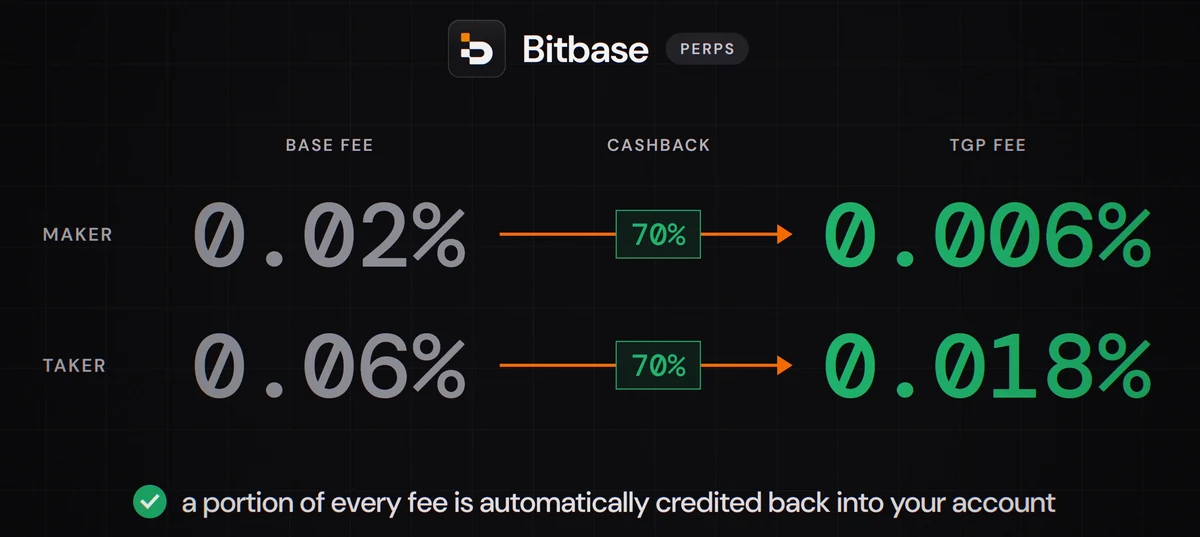
Regular Bitbase futures rates before and after 70% cashback.
Here’s what that looks like over a month of futures trading with taker orders at the regular rate:
| Monthly futures volume | Fees at 0.06% | 70% back | What you really pay |
|---|---|---|---|
| $50,000 | $30 | $21 | $9 |
| $250,000 | $150 | $105 | $45 |
| $1,000,000 | $600 | $420 | $180 |
At higher volumes your VIP level lowers the rate first. At $100 million a month, which reaches VIP 5 and its 0.035% taker rate, the fees come to $35,000 and the cashback to $24,500.
One exception: fees paid with a Bitbase futures bonus don’t earn referral commission, so that part earns no cashback either.
Start trading on Bitbase with lower fees
Sign up through TradeGetPaid and 70% of your Bitbase spot and futures trading fees come back to you automatically.
Fees change, so check your own rate on Bitbase’s fee page before you trade. Official sources: fee page, VIP fee adjustment notice, funding rate history, TradFi.
Frequently asked questions
A regular account pays 0.10% maker and 0.10% taker on spot, and 0.02% maker and 0.06% taker on futures. VIP levels lower both.
Not at VIP 0, where makers and takers both pay 0.10%. From VIP 1 the maker rate is lower: 0.08% against 0.09% for takers.
Yes. Each side is charged separately, on the price and size of that trade, at the maker or taker rate of that order.
Every 8 hours on BTCUSDT. Some contracts, such as gold, settle every 4 hours. You only pay or receive funding if your position is open at settlement.
Meet any one of these: 30,000 USDT in your account, 5,000,000 USDT of 30-day futures volume, or 500,000 USDT of 30-day spot volume.
No. Perpetual futures on stocks, forex, commodities and indices pay the same rates as crypto futures, and tokenized stocks and gold pay the spot rate.